







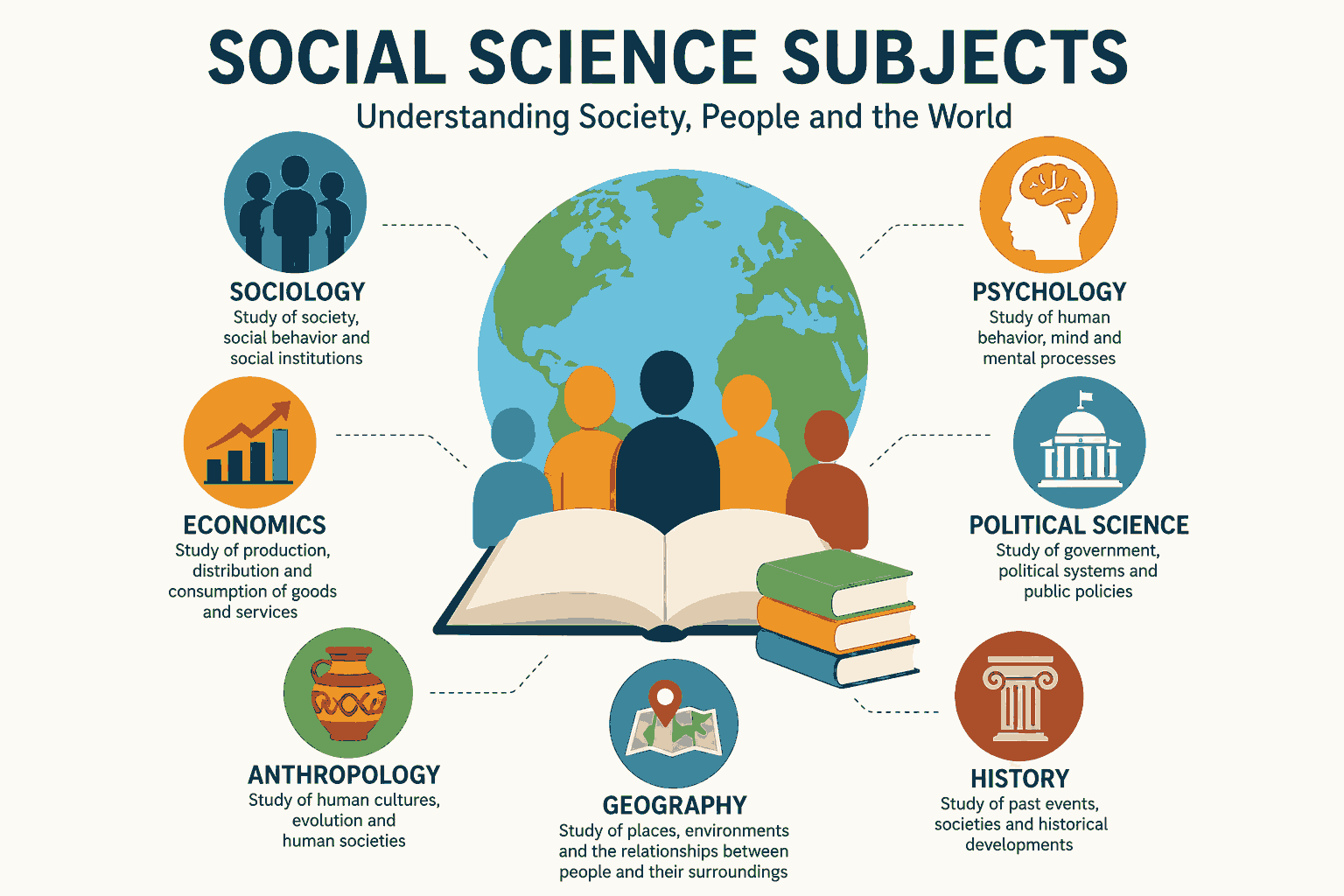
Social science subjects play a crucial role in helping us understand how individuals, communities, institutions, and nations function. From studying human behavior and cultural traditions to analyzing political systems and economic trends, social science provide valuable insights into the forces that shape our daily lives.
In today’s interconnected world, social science subjects have become more important than ever. Governments rely on social science research to develop policies, businesses use social science principles to understand consumer behavior, and educators use social science knowledge to help students become informed citizens. Whether you are a student choosing academic courses, a parent exploring educational opportunities, or simply someone interested in understanding society, learning about social science subjects can provide a deeper perspective on the world around you.
This comprehensive guide explores the major social science subjects, their importance, career opportunities, educational benefits, and their impact on modern society.
What Are Social Science Subjects?
Social science subjects are academic disciplines that study human society, social relationships, institutions, and behavior. Unlike natural sciences, which focus on the physical world, social science subjects examine how people interact with one another and how societies evolve over time.
The primary goal of social science subjects is to understand:
- Human behavior
- Social structures
- Cultural development
- Economic systems
- Political institutions
- Historical events
- Geographic influences on society
Students who study social science learn critical thinking, analytical reasoning, research methods, and communication skills that are valuable across numerous professions.
Why Social Science Subjects Are Important
Understanding Human Behavior
One of the biggest advantages of studying social science is gaining insight into human behavior. These disciplines help explain why people make certain decisions, how social groups form, and what factors influence attitudes and beliefs.
Understanding human behavior is essential in:
- Education
- Healthcare
- Government
- Marketing
- Public administration
- Community development
Building Better Societies
Social science subjects contribute significantly to creating fairer and more effective societies. Policymakers use research from social scientists to address issues such as:
- Poverty
- Crime
- Inequality
- Education
- Healthcare access
- Environmental sustainability
Developing Critical Thinking Skills
Students who study social science subjects learn to evaluate evidence, analyze arguments, and interpret complex information. These skills are highly valued in both academic and professional settings.
Major Social Science Subjects Explained
Sociology
What Is Sociology?
Sociology is one of the most widely studied social science subjects. It focuses on understanding society, social institutions, and group behavior.
Sociologists examine topics such as:
- Family structures
- Social inequality
- Education systems
- Religion
- Crime
- Urbanization
Why Sociology Matters
Sociology helps us understand how social forces influence individual behavior. It provides tools for analyzing societal problems and developing practical solutions.
Career Opportunities in Sociology
- Social worker
- Research analyst
- Community development officer
- Human resources specialist
- Policy advisor
Psychology
Understanding Human Minds
Psychology is among the most popular social science subjects because it studies mental processes and human behavior.
Psychologists explore:
- Emotions
- Memory
- Learning
- Personality
- Mental health
- Cognitive development
Applications of Psychology
Psychology influences many aspects of daily life, including:
- Education
- Workplace productivity
- Healthcare
- Sports performance
- Marketing strategies
Careers in Psychology
- Clinical psychologist
- Counselor
- School psychologist
- Behavioral analyst
- Organizational consultant
Economics
What Economics Studies
Economics examines how individuals, businesses, and governments allocate resources.
As one of the most influential social science subjects, economics focuses on:
- Supply and demand
- Inflation
- Employment
- Economic growth
- International trade
- Financial systems
Importance of Economics
Economics helps societies make informed decisions regarding resource distribution and economic development.
Economics Careers
- Economist
- Financial analyst
- Investment consultant
- Economic researcher
- Government advisor
Political Science
Studying Governments and Power
Political science investigates political systems, governance, public policies, and international relations.
Among modern social science subjects, political science is essential for understanding:
- Democracy
- Elections
- Political ideologies
- International diplomacy
- Public administration
Why Political Science Matters
Political science promotes civic awareness and informed participation in democratic processes.
Career Paths
- Political analyst
- Diplomat
- Public administrator
- Policy researcher
- Legislative assistant
Anthropology
Exploring Human Cultures
Anthropology studies human societies, cultures, and evolution.
This fascinating branch of social science subjects investigates:
- Cultural traditions
- Human origins
- Social customs
- Language development
- Archaeological discoveries
Types of Anthropology
Cultural Anthropology
Examines living cultures and traditions.
Archaeology
Studies ancient civilizations through material remains.
Biological Anthropology
Investigates human evolution and biological development.
Career Opportunities
- Anthropologist
- Museum curator
- Archaeologist
- Cultural consultant
- Academic researcher
Geography
More Than Maps
Geography is one of the most practical social science subjects because it examines the relationship between people and their environments.
Topics include:
- Population distribution
- Climate impacts
- Urban planning
- Migration
- Natural resources
Importance of Geography
Geography helps governments and organizations plan for sustainable development and environmental management.
Geography Careers
- Urban planner
- Environmental consultant
- GIS specialist
- Cartographer
- Geographic researcher
History
Learning From the Past
History studies past events, civilizations, and societal transformations.
Although often considered a humanities discipline, history frequently overlaps with social science subjects because it analyzes social and political developments.
Benefits of Studying History
Students learn:
- Research skills
- Source evaluation
- Historical interpretation
- Critical analysis
Career Options
- Historian
- Archivist
- Teacher
- Researcher
- Museum specialist
Interdisciplinary Nature of Social Science Subjects
How Different Disciplines Work Together
Modern challenges rarely fit within a single academic field. Therefore, social science subjects often overlap.
For example:
- Economists study poverty.
- Sociologists examine social inequality.
- Political scientists evaluate policy solutions.
- Psychologists analyze behavioral impacts.
Together, these perspectives provide a complete understanding of complex issues.
Addressing Global Challenges
Many global problems require knowledge from multiple social science subjects, including:
- Climate change
- Public health
- Migration
- Economic inequality
- Political conflict
Benefits of Studying Social Science Subjects
Improved Communication Skills
Students regularly engage in:
- Writing essays
- Conducting research
- Delivering presentations
- Participating in discussions
These activities strengthen communication abilities.
Enhanced Research Skills
Many social science subjects involve collecting, analyzing, and interpreting data.
Students learn:
- Survey design
- Statistical analysis
- Interview techniques
- Data interpretation
Better Decision-Making
Social science education encourages evidence-based thinking and informed decision-making.
Global Awareness
Studying social science subjects exposes students to diverse cultures, perspectives, and experiences.
This promotes:
- Cultural understanding
- Empathy
- International awareness
Social Science Subjects in Modern Education
Primary Education
Students are introduced to basic concepts such as:
- Community
- Citizenship
- Geography
- History
Secondary Education
More advanced social science subjects are introduced, including:
- Economics
- Government
- Sociology
- Geography
- World history
Higher Education
Universities offer specialized programs across numerous social science, enabling students to develop expertise in specific areas.
Career Opportunities Created by Social Science Subjects
Government and Public Service
Graduates of social science subjects frequently work in:
- Public administration
- Policy development
- International relations
- Urban planning
Business and Corporate Roles
Employers value social science graduates because they possess:
- Analytical thinking
- Research expertise
- Communication skills
- Problem-solving abilities
Education
Teaching remains a significant career path for those studying social science subjects.
Research and Academia
Researchers contribute to:
- Policy analysis
- Academic knowledge
- Social development programs
Nonprofit Organizations
Many graduates support humanitarian initiatives and social programs.
Technology and the Future of Social Science Subjects
Data-Driven Research
Modern technology has transformed how researchers study society.
Today’s social scientists use:
- Big data
- Artificial intelligence
- Machine learning
- Geographic information systems
These tools help analyze large volumes of social information.
Digital Sociology
Researchers now study:
- Social media behavior
- Online communities
- Digital communication
- Virtual identities
Future Trends
Emerging areas within social science include:
- Digital governance
- Cyber psychology
- Behavioral economics
- Social data analytics
These fields are expected to grow rapidly in coming years.
Challenges Facing Social Science Subjects
Misinformation
The spread of false information creates challenges for researchers and educators.
Rapid Social Change
Technological advancement and globalization continuously reshape societies.
Funding Limitations
Some social science programs face financial constraints despite their societal importance.
Ethical Considerations
Researchers must ensure:
- Participant privacy
- Informed consent
- Responsible data use
These ethical standards remain central to all social science subjects.
How Social Science Shape Everyday Life
Many people underestimate how often social science subjects influence daily decisions.
Examples include:
- Economic policies affecting prices
- Political decisions shaping laws
- Psychological principles used in advertising
- Geographic planning influencing transportation
- Sociological research improving education systems
Every aspect of modern life is connected to insights generated through social science subjects.
Choosing the Right Social Science Subject
Consider Your Interests
If you enjoy understanding people, psychology may be ideal.
If you are interested in governments and leadership, political science could be the right choice.
Those fascinated by cultures may prefer anthropology.
Students who enjoy numbers and market trends often choose economics.
Evaluate Career Goals
Different social science subjects support different career paths.
Research potential opportunities before selecting a specialization.
Explore University Programs
Review curriculum structures and internship opportunities to identify programs that align with your goals.
The Global Relevance of Social Science Subjects
The modern world faces increasingly complex challenges.
Governments, businesses, and communities rely on experts trained in social science to address:
- Economic instability
- Social inequality
- Political conflict
- Climate adaptation
- Public health crises
Without the knowledge generated by social science, societies would struggle to understand and solve these issues effectively.
Conclusion
Social science subjects are essential for understanding how societies function and how individuals interact within social systems. From sociology and psychology to economics, political science, geography, anthropology, and history, these disciplines provide valuable insights into human behavior, culture, governance, and development.
The importance of social science continues to grow as societies become more interconnected and complex. They help policymakers create better solutions, enable businesses to understand consumers, support educational advancement, and foster informed citizenship.
Whether pursued for academic enrichment, professional development, or personal curiosity, social science subjects offer powerful tools for understanding the world and contributing positively to society.
Also Read: Complete Maths Tutor: The Ultimate Guide to Personalized Mathematics Learning and Academic Success
Frequently Asked Questions (FAQs)
1. What are the main social science subjects?
The primary social science include sociology, psychology, economics, political science, anthropology, geography, and history. These disciplines study different aspects of human society and behavior.
2. Why are social science important for students?
Social science help students develop critical thinking, communication, research, and analytical skills while improving their understanding of social issues and global challenges.
3. What careers can I pursue with social science?
Graduates can work in education, government, public policy, research, business, human resources, international relations, social work, consulting, and nonprofit organizations.
















+ There are no comments
Add yours