






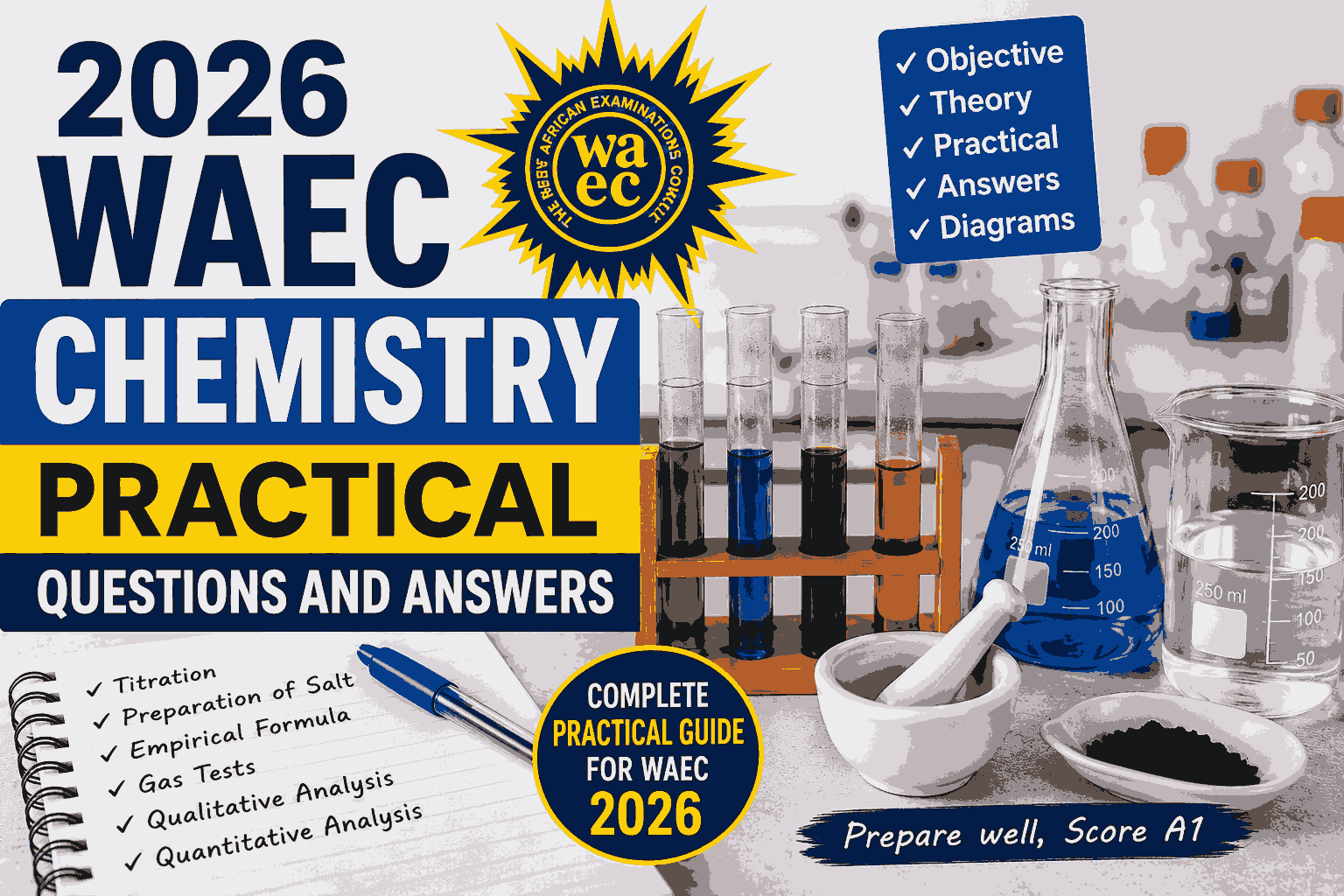
Many students searching for 2026 WAEC Chemistry Practical Questions and Answers are looking for ways to prepare effectively for one of the most important sections of the West African Senior School Certificate Examination (WASSCE). While no legitimate source can provide the actual 2026 WAEC Chemistry Practical Questions and Answers before the examination, candidates can significantly improve their performance by understanding the structure of the practical paper, mastering laboratory techniques, and practicing commonly tested experiments.
This comprehensive guide explains everything students need to know about 2026 WAEC Chemistry Practical Questions and Answers, including specimen identification, qualitative analysis, quantitative analysis, laboratory calculations, exam strategies, and frequently tested practical concepts.
Understanding the WAEC Chemistry Practical Examination
What Is the Chemistry Practical Paper?
The WAEC Chemistry Practical examination is designed to assess a student’s ability to apply theoretical knowledge in a laboratory setting. Instead of testing memorization alone, the examination evaluates observation skills, analytical thinking, calculation accuracy, and laboratory competence.
Students searching for 2026 WAEC Chemistry Practical Questions and Answers should first understand that the practical paper typically focuses on:
- Volumetric analysis
- Qualitative analysis
- Salt identification
- Laboratory observations
- Chemical reactions
- Experimental calculations
- Scientific reporting
A strong understanding of these areas gives candidates a significant advantage.
Expected Areas of Focus in 2026 WAEC Chemistry Practical
Volumetric Analysis
Volumetric analysis remains one of the most consistent topics in WAEC Chemistry Practical examinations.
Candidates may be required to:
- Perform titration experiments
- Record burette readings
- Calculate average titres
- Determine concentration values
- Apply mole concepts
Important skills include:
Reading Apparatus Correctly
Students should know how to read:
- Burettes
- Pipettes
- Measuring cylinders
- Volumetric flasks
Performing Accurate Calculations
Common calculations involve:
- Molarity
- Number of moles
- Concentration
- Percentage purity
Students preparing for 2026 WAEC Chemistry Practical Questions and Answers should practice titration calculations regularly.
Qualitative Analysis and Salt Identification
Identifying Chemical Substances
Qualitative analysis often requires students to identify unknown salts through observation and chemical testing.
Common observations include:
Colour Changes
Students may observe:
- Blue precipitates
- White precipitates
- Green precipitates
- Brown precipitates
Gas Evolution
Candidates should recognize gases such as:
Hydrogen
Characteristics:
- Burns with a pop sound
Oxygen
Characteristics:
- Rekindles a glowing splint
Carbon Dioxide
Characteristics:
- Turns limewater milky
Ammonia
Characteristics:
- Pungent smell
- Turns moist red litmus paper blue
Understanding these observations is essential when preparing for 2026 WAEC Chemistry Practical Questions and Answers.
Common Laboratory Apparatus Every Candidate Must Know
Essential Equipment
Students should be familiar with the following apparatus:
- Test tube
- Burette
- Pipette
- Beaker
- Conical flask
- Funnel
- Retort stand
- Wash bottle
- Measuring cylinder
- Crucible
Functions of Laboratory Apparatus
Candidates may be asked to state the uses of laboratory equipment.
Examples include:
| Apparatus | Function |
|---|---|
| Burette | Accurate measurement of liquids during titration |
| Pipette | Transfer of fixed liquid volume |
| Beaker | Mixing and heating substances |
| Funnel | Filtration and transfer of liquids |
| Crucible | Strong heating of solids |
Important Chemical Tests Students Should Master
Test for Cations
Common ions include:
Copper (II) Ion
Observations:
- Blue precipitate with sodium hydroxide
- Blue solution
Iron (II) Ion
Observations:
- Green precipitate
Iron (III) Ion
Observations:
- Brown precipitate
Zinc Ion
Observations:
- White precipitate
- Soluble in excess sodium hydroxide
Test for Anions
Chloride Ion
Observation:
- White precipitate with silver nitrate
Sulphate Ion
Observation:
- White precipitate with barium chloride
Carbonate Ion
Observation:
- Effervescence when acid is added
These reactions frequently appear in preparation materials related to 2026 WAEC Chemistry Practical Questions and Answers.
How to Answer WAEC Chemistry Practical Questions Correctly
Record Observations Accurately
Many candidates lose marks because they write conclusions instead of observations.
Wrong Example
“Salt contains copper.”
Correct Example
“Blue solution formed.”
Examiners award marks for observations first before conclusions.
Present Results in Tables
Well-organized tables improve clarity.
Example:
| Test | Observation | Inference |
|---|---|---|
| Add NaOH | Blue precipitate formed | Cu²⁺ may be present |
Show Calculations Clearly
Always show:
- Formula used
- Substitution
- Working
- Final answer
Common Mistakes Candidates Must Avoid
Poor Reading of Burette Values
Candidates should always read at eye level.
Incorrect Significant Figures
WAEC often awards marks for proper presentation of results.
Skipping Units
Always include:
- cm³
- mol/dm³
- g
- g/mol
Rushing Through Experiments
Take time to:
- Verify readings
- Repeat measurements
- Check calculations
Students searching for 2026 WAEC Chemistry Practical Questions and Answers should focus on avoiding these common mistakes rather than searching for supposed leaks.
Effective Preparation Strategy for the 2026 WAEC Chemistry Practical
Study the Official WAEC Syllabus
The most reliable preparation resource is the official WAEC Chemistry syllabus.
Useful resource:
Practice Past Practical Exercises
Focus on:
- Titration
- Salt analysis
- Laboratory observations
- Calculations
Use Recommended Textbooks
Examples include:
- New School Chemistry
- Comprehensive Certificate Chemistry
- Essential Chemistry
Attend Practical Sessions
Hands-on laboratory practice builds confidence and accuracy.
Form Study Groups
Collaborative learning helps students understand practical procedures more effectively.
Why Students Should Avoid Exam Leaks
Risks of Fake Questions
Many websites claim to provide 2026 WAEC Chemistry Practical Questions and Answers, but most information shared before examinations is unreliable.
Problems include:
- Wrong answers
- Outdated materials
- Scams
- Academic misconduct
The safest strategy is proper preparation using legitimate resources.
Also Read: Arts Subjects: Complete Guide to Arts Subjects, Career Opportunities, and University Courses
Final Thoughts on 2026 WAEC Chemistry Practical Questions and Answers
Students looking for 2026 WAEC Chemistry Practical Questions and Answers should understand that success in Chemistry Practical comes from preparation, not leaked materials. By mastering titration techniques, qualitative analysis, laboratory apparatus, chemical tests, and calculation methods, candidates can approach the examination with confidence.
The most effective way to excel is to study the WAEC syllabus thoroughly, practice laboratory exercises consistently, and develop strong observation and analytical skills. These strategies will help students perform well regardless of the exact questions that appear in the examination.
Also Read: What Are the 5 Compulsory Subjects in WAEC? Complete Guide for Students
FAQs
Can anyone provide genuine 2026 WAEC Chemistry Practical questions before the exam?
No. Any source claiming to have the actual examination questions before the official examination should be treated with caution. Students should rely on legitimate preparation methods.
What topics are most important for WAEC Chemistry Practical?
The most important areas usually include volumetric analysis, qualitative analysis, salt identification, laboratory observations, and calculation-based experiments.
How can I score high in WAEC Chemistry Practical?
Practice laboratory experiments regularly, master titration calculations, learn common ion tests, record observations accurately, and follow the WAEC Chemistry syllabus carefully.







+ There are no comments
Add yours