





WAEC is one of the most important examinations for secondary school students in Nigeria and other West African countries. Every year, thousands of candidates register for the examination with the goal of gaining admission into universities, polytechnics, colleges of education, and other higher institutions.
One of the most common questions students ask is: What are the 5 compulsory subjects in WAEC? Understanding these subjects is essential because they form the foundation of your WAEC result and can determine whether you meet the requirements for further education.
In this comprehensive guide, we explain the five compulsory subjects in WAEC, why they are important, how they affect admission, and other key information every student should know.
Understanding WAEC and Its Importance
The West African Examinations Council (WAEC) is the body responsible for conducting standardized examinations for students in West African countries, including Nigeria, Ghana, Sierra Leone, Liberia, and The Gambia.
The examination serves several purposes:
- Qualification for higher education.
- Employment opportunities.
- Professional certification requirements.
- Academic assessment and certification.
A good WAEC result can open doors to numerous educational and career opportunities.
What Are the 5 Compulsory Subjects in WAEC?
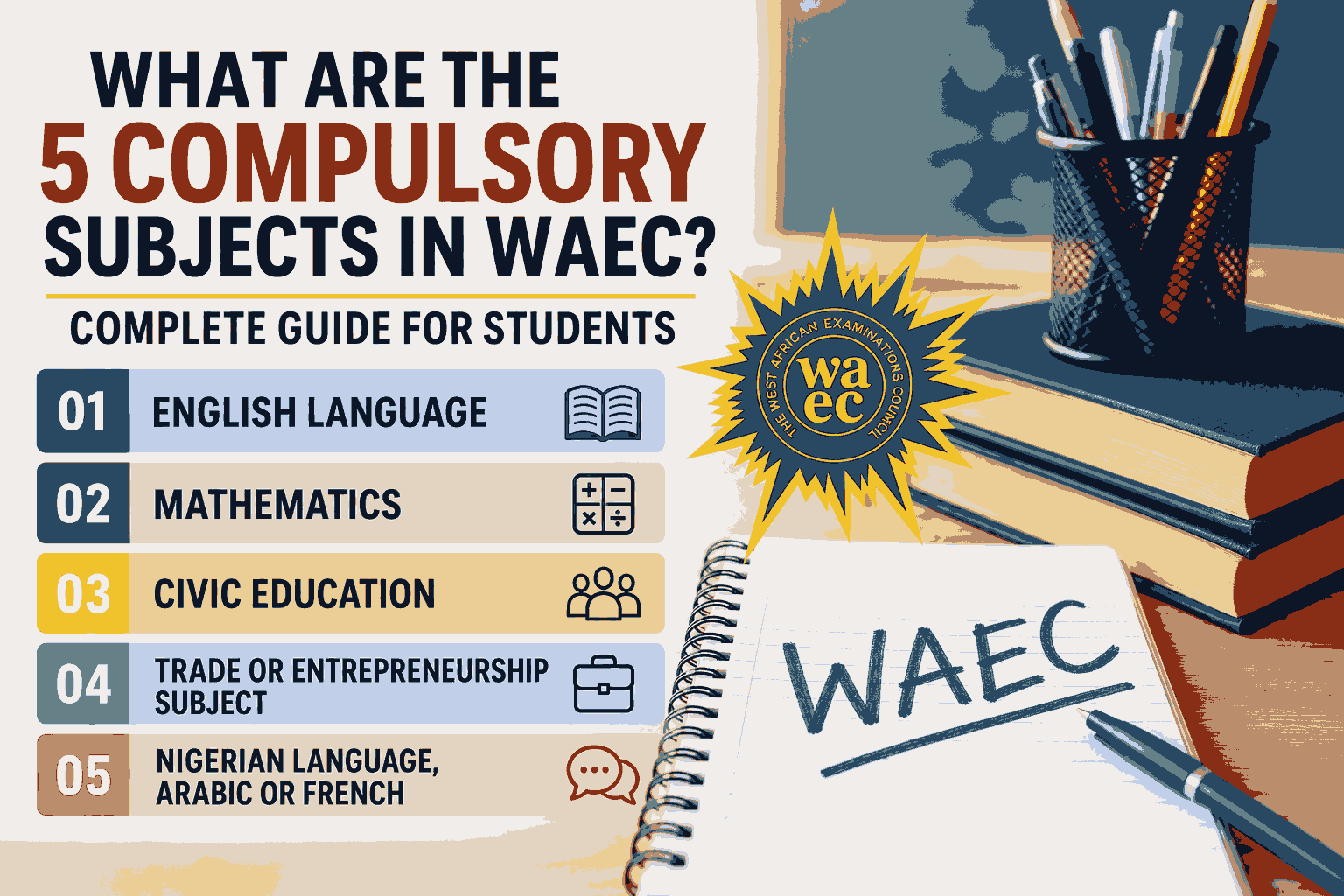
The five compulsory subjects in WAEC are:
- English Language
- Mathematics
- Civic Education
- One Trade or Entrepreneurship Subject
- One Nigerian Language or Arabic/French (depending on the school curriculum)
These subjects are generally compulsory for students in Nigerian secondary schools and form part of the minimum requirements for WAEC registration.
Let us examine each subject in detail.
1. English Language
Why English Language Is Compulsory
English Language is arguably the most important subject in WAEC because it serves as Nigeria’s official language and the primary language of instruction in most educational institutions.
Virtually every university, polytechnic, and college of education requires a credit pass in English Language before granting admission.
Topics Covered in English Language
Students are tested in:
- Comprehension
- Summary writing
- Essay writing
- Lexis and structure
- Oral English
Importance of Passing English
A credit pass in English Language helps students:
- Meet admission requirements.
- Improve communication skills.
- Perform better in tertiary education.
Without English Language, gaining admission into most higher institutions becomes extremely difficult.
2. Mathematics
Why Mathematics Is a Compulsory Subject
Mathematics is another core subject that every WAEC candidate must take.
The subject develops problem-solving and analytical skills needed in everyday life and professional careers.
Areas Covered in Mathematics
Students learn:
- Algebra
- Geometry
- Statistics
- Trigonometry
- Probability
- Number systems
Importance of Mathematics
A credit pass in Mathematics is required for many courses such as:
- Engineering
- Medicine
- Accounting
- Computer Science
- Economics
- Architecture
Even students pursuing arts and social science courses are often required to have at least a pass or credit in Mathematics.
3. Civic Education
The Role of Civic Education in WAEC
Civic Education has become a compulsory subject because it teaches students about their rights, duties, and responsibilities as citizens.
The subject helps build responsible individuals who understand governance and national values.
Topics Covered
Students study:
- Human rights
- Democracy
- Rule of law
- National values
- Citizenship
- Public service
Benefits of Civic Education
The subject helps students:
- Understand their civic responsibilities.
- Become responsible citizens.
- Appreciate democratic principles.
Civic Education is compulsory regardless of the student’s field of study.
4. Trade or Entrepreneurship Subject
Why Trade Subjects Are Included
The Nigerian educational curriculum emphasizes entrepreneurship and vocational skills.
As a result, students are required to register at least one trade subject.
Examples of Trade Subjects
Some common trade subjects include:
- Marketing
- Catering Craft Practice
- Data Processing
- Photography
- Garment Making
- Animal Husbandry
- Fisheries
- Tourism
- Salesmanship
- Office Practice
Importance of Trade Subjects
Trade subjects help students:
- Acquire practical skills.
- Develop entrepreneurial abilities.
- Become self-employed after school.
These subjects are designed to reduce unemployment by encouraging skill acquisition.
5. Nigerian Language, Arabic, or French
Language Education in WAEC
Depending on the school and state curriculum, students are usually required to study a language subject.
Examples include:
- Yoruba
- Igbo
- Hausa
- Arabic
- French
Importance of Language Subjects
Language education helps students:
- Preserve cultural heritage.
- Improve communication abilities.
- Promote national unity.
- Gain multilingual skills.
Students often perform well in these subjects because they relate closely to their cultural and social backgrounds.
Are These the Only Subjects You Will Write in WAEC?
No.
Although these are compulsory subjects, every candidate must register additional subjects depending on their chosen field of study.
Most students register between eight and nine subjects.
Science Students
Examples include:
- Physics
- Chemistry
- Biology
- Agricultural Science
Commercial Students
Examples include:
- Financial Accounting
- Commerce
- Economics
- Office Practice
Art Students
Examples include:
- Literature in English
- Government
- Christian Religious Studies
- Islamic Religious Studies
- History
How Many Subjects Must You Pass in WAEC?
To obtain a complete WAEC certificate, students are expected to pass a minimum number of subjects.
Generally, candidates aim to obtain:
- At least five credits.
- Credits in English Language and Mathematics.
- Credits in subjects relevant to their intended course of study.
Many universities require five credits obtained in not more than two sittings.
Why the 5 Compulsory Subjects Matter for University Admission
The five compulsory subjects in WAEC play a significant role in admission processes.
University Admission
Most universities require:
- Credit in English Language.
- Credit in Mathematics.
- Relevant credits for the chosen course.
Polytechnic Admission
Polytechnics also place emphasis on:
- English Language.
- Mathematics.
- Relevant departmental subjects.
College of Education Admission
Colleges of education similarly require passes or credits in core WAEC subjects.
A poor performance in compulsory subjects can limit available admission opportunities.
Common Mistakes Students Make Regarding WAEC Compulsory Subjects
Many students make errors that affect their registration and examination performance.
These mistakes include:
Ignoring English Language
Some students focus more on science or commercial subjects and neglect English Language.
Underestimating Mathematics
Mathematics is often considered difficult, causing some students to avoid proper preparation.
Poor Subject Combination
Choosing incorrect elective subjects can affect admission eligibility.
Late Preparation
Waiting until the examination period before studying usually leads to poor results.
Incomplete Registration
Failure to register compulsory subjects can create serious academic problems.
Tips for Passing the 5 Compulsory Subjects in WAEC
Success in WAEC requires planning and discipline.
Create a Study Timetable
Allocate sufficient time to each compulsory subject.
Practice Past Questions
Past questions help students understand examination patterns.
Attend Classes Regularly
Consistent attendance improves understanding.
Join Study Groups
Group discussions can enhance learning.
Seek Help When Necessary
Students should ask teachers for clarification whenever they encounter difficulties.
Focus on Weak Areas
Extra attention should be given to subjects where performance is low.
The Relationship Between WAEC and JAMB
Many students confuse WAEC and JAMB requirements.
WAEC serves as:
- Secondary school certification.
- Evidence of academic qualification.
JAMB serves as:
- University entrance examination.
To gain admission, candidates generally need both a good WAEC result and a competitive JAMB score.
Frequently Asked Questions About WAEC Compulsory Subjects
1. What are the five compulsory subjects in WAEC?
The five compulsory subjects in WAEC generally include English Language, Mathematics, Civic Education, one Trade Subject, and a Nigerian Language, Arabic, or French depending on the school curriculum.
2. Can I gain admission without a credit in Mathematics?
It depends on the course and institution. However, many universities require a credit in Mathematics, making it highly important for admission.
3. Is Civic Education compulsory in WAEC?
Yes. Civic Education is one of the compulsory subjects that all candidates are expected to register and write.
Also Read: Can I Write WAEC Twice? Everything You Need to Know
Conclusion
Understanding what are the 5 compulsory subjects in WAEC is crucial for every secondary school student preparing for the examination. These subjects English Language, Mathematics, Civic Education, a Trade Subject, and a Language Subject form the foundation of a student’s academic assessment and play a major role in university admission.
Students should not only register these compulsory subjects but also dedicate sufficient time to studying them. A strong performance in these subjects significantly increases the chances of securing admission into higher institutions and achieving future academic success. By preparing early, practicing consistently, and focusing on core concepts, candidates can excel in WAEC and move confidently toward their educational goals.








+ There are no comments
Add yours