






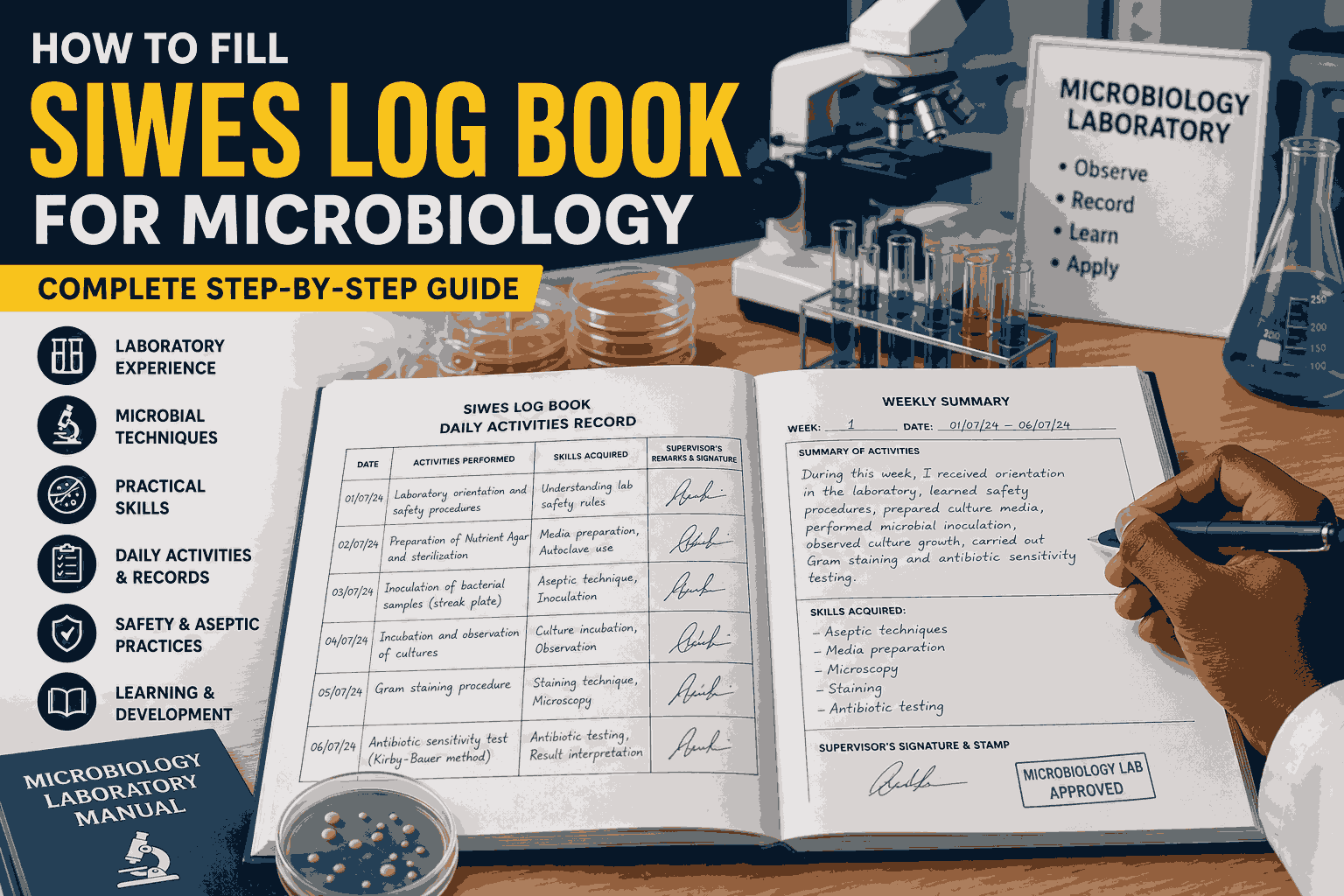
If you are a microbiology student undergoing the Students Industrial Work Experience Scheme (SIWES), one of the most important documents you will submit at the end of your industrial training is your SIWES log book. Unfortunately, many students lose valuable marks because they do not know how to fill SIWES log book for microbiology correctly.
Your SIWES log book is not just a record book. It is official evidence of the practical skills, laboratory procedures, industrial exposure, and microbiological techniques you learned during your training. Supervisors, lecturers, and Industrial Training Fund (ITF) officials use it to assess your performance and determine whether you actively participated in your assigned duties.
Understanding how to fill SIWES log book for microbiology properly can significantly improve your final SIWES grade. Whether you are attached to a microbiology laboratory, pharmaceutical company, food processing industry, brewery, water treatment plant, research institute, diagnostic laboratory, or hospital laboratory, this guide provides everything you need to know.
According to the Industrial Training Fund (ITF), SIWES was established to bridge the gap between classroom theory and practical industrial experience, allowing students to acquire relevant workplace skills before graduation.
What Is a SIWES Log Book?
A SIWES log book is an official document issued to students participating in industrial training. It contains records of daily activities, weekly tasks, laboratory procedures, observations, supervisor remarks, attendance records, and monthly evaluations completed during the SIWES period.
The primary purpose of the log book is to:
- Document practical experience gained.
- Monitor student progress.
- Provide evidence of industrial exposure.
- Assist supervisors in evaluating performance.
- Serve as a reference when writing the SIWES report.
Students who understand how to fill SIWES log book for microbiology often produce more organized and professional records than those who simply copy random entries.
Why Microbiology Students Must Fill Their SIWES Log Book Properly
The Importance of Accurate Documentation
Microbiology is a laboratory-based discipline that requires precision, observation, and proper documentation. Every experiment, sample collection, microbial analysis, and sterilization process should be properly recorded.
When supervisors review your log book, they want to see:
- Skills acquired.
- Equipment used.
- Laboratory procedures performed.
- Safety measures observed.
- Practical knowledge gained.
A well-documented SIWES log book demonstrates professionalism and seriousness.
Research on SIWES effectiveness consistently shows that quality documentation and properly maintained logbooks contribute significantly to student assessment outcomes.
How to Fill SIWES Log Book for Microbiology: Front Pages Explained
1. Student Information Page
The first page usually requires personal and academic information.
Fill in:
- Full Name
- Matric Number
- Institution Name
- Department (Microbiology)
- Faculty
- Level
- Phone Number
- Address
- Passport Photograph
- Name of Industrial Supervisor
- Name of School Supervisor
Ensure every detail is accurate and written clearly.
2. Organization Profile Page
This section contains information about the company or laboratory where you are attached.
Include:
- Organization Name
- Address
- Nature of Business
- Services Offered
- Number of Staff
- Laboratory Units
- Organizational Structure
Example:
Organization Name: XYZ Diagnostic Laboratory
Nature of Business: Medical microbiology testing, microbial identification, culture analysis, antibiotic sensitivity testing, and laboratory diagnostics.
Many SIWES guides recommend carefully completing the organization profile because it provides context for all subsequent activities recorded in the logbook.
Daily Activities: The Most Important Part of Your SIWES Log Book
What Should Be Recorded Daily?
When learning how to fill SIWES log book for microbiology, the daily activity section deserves the most attention.
Every day should contain:
- Date
- Department visited
- Activity performed
- Equipment used
- Observations made
- Skills learned
Avoid vague statements such as:
Worked in the laboratory.
Instead write:
Observed preparation of Nutrient Agar media and sterilization using an autoclave at 121°C for 15 minutes.
Specific entries always attract better evaluation.
Example Daily Entries for Microbiology Students
Monday
Observed laboratory orientation and introduction to microbiology laboratory safety procedures.
Tuesday
Learned proper handwashing techniques, aseptic procedures, and use of personal protective equipment (PPE).
Wednesday
Observed preparation of culture media including Nutrient Agar and MacConkey Agar.
Thursday
Participated in sterilization of laboratory equipment using autoclave.
Friday
Observed microbial inoculation techniques and streak plate method.
These examples show exactly how to fill SIWES log book for microbiology professionally.
Weekly SIWES Log Book Entries for Microbiology Students
Week One Example
Activities Performed
- Laboratory orientation.
- Introduction to laboratory safety.
- Identification of laboratory equipment.
- Observation of sterilization processes.
- Preparation of culture media.
Skills Acquired
- Aseptic techniques.
- Laboratory safety procedures.
- Media preparation principles.
Week Two Example
Activities Performed
- Media preparation.
- Culture inoculation.
- Colony observation.
- Gram staining procedures.
- Microscopic examination.
Skills Acquired
- Staining techniques.
- Microbial observation.
- Sample handling.
Week Three Example
Activities Performed
- Water sample collection.
- Bacterial culture.
- Total viable count determination.
- Record keeping.
Skills Acquired
- Environmental microbiology techniques.
- Water quality analysis.
Laboratory Activities Microbiology Students Can Record
Microbial Culture Procedures
When learning how to fill SIWES log book for microbiology, you should document microbial culture activities such as:
- Sample collection.
- Inoculation.
- Incubation.
- Colony counting.
- Culture preservation.
Example:
“Performed inoculation of bacterial samples on Nutrient Agar plates using aseptic techniques and incubated at 37°C for 24 hours.”
Gram Staining Procedures
Example Entry:
“Observed and participated in Gram staining procedure for differentiation of Gram-positive and Gram-negative bacteria using crystal violet, iodine solution, alcohol decolorizer, and safranin.”
Microscopy
Example Entry:
“Examined stained bacterial smears under oil immersion lens and recorded microbial morphology.”
Antibiotic Sensitivity Testing
Example Entry:
“Observed Kirby-Bauer antibiotic susceptibility testing and measured zones of inhibition after incubation.”
How to Fill SIWES Log Book for Microbiology in Different Industries
Hospital Laboratory Placement
If attached to a hospital laboratory, activities may include:
- Urine culture.
- Blood culture.
- Stool examination.
- Antibiotic susceptibility testing.
- Specimen processing.
Example:
“Received and processed urine samples for microbial culture and identification.”
Food Industry Placement
Food microbiology students may record:
- Food sampling.
- Quality control testing.
- Contamination monitoring.
- Shelf-life assessment.
Example:
“Conducted microbial analysis of processed food samples for quality assurance purposes.”
Water Treatment Laboratory
Activities include:
- Water sample analysis.
- Coliform detection.
- Microbial monitoring.
Example:
“Performed total coliform count on treated water samples using membrane filtration technique.”
Pharmaceutical Industry Placement
Activities include:
- Sterility testing.
- Environmental monitoring.
- Quality control analysis.
Example:
“Observed microbial limit testing on pharmaceutical products.”
Common Laboratory Equipment to Mention in Your SIWES Log Book
A good understanding of how to fill SIWES log book for microbiology involves mentioning equipment used.
Examples include:
Sterilization Equipment
- Autoclave
- Hot Air Oven
Observation Equipment
- Microscope
- Colony Counter
Laboratory Tools
- Petri Dishes
- Pipettes
- Inoculating Loops
- Test Tubes
Measurement Equipment
- pH Meter
- Spectrophotometer
- Incubator
Mentioning equipment demonstrates practical exposure.
Mistakes to Avoid When Filling Your SIWES Log Book
1. Writing Vague Statements
Poor:
“Worked in laboratory.”
Better:
“Prepared Nutrient Agar media and sterilized using autoclave.”
2. Copying Other Students’ Entries
Your log book should reflect your actual experiences.
3. Leaving Pages Blank
Blank pages create the impression of absenteeism.
4. Using Correction Fluid Excessively
Maintain neatness and professionalism.
5. Forgetting Supervisor Signatures
Many students complete their entries but forget supervisor approval.
SIWES experts consistently emphasize that supervisor signatures and proper documentation are essential components of logbook assessment.
How Supervisors Assess Your SIWES Log Book
Supervisors often evaluate:
Attendance
Regular presence at work.
Practical Skills
Ability to perform assigned tasks.
Learning Ability
Willingness to acquire knowledge.
Documentation
Quality of records kept.
Professional Conduct
Behavior and punctuality.
A properly completed log book significantly improves assessment outcomes.
Sample Four-Week SIWES Log Book Summary for Microbiology Students
Month One Summary
During the first month of SIWES, I received laboratory orientation and learned standard laboratory safety procedures. I observed media preparation, sterilization techniques, microbial inoculation methods, and culture incubation processes. I gained practical exposure to microbiological laboratory operations and proper documentation procedures.
Month Two Summary
Participated in Gram staining, microscopy, bacterial isolation, colony counting, and microbial identification procedures. Developed competence in laboratory techniques and interpretation of microbiological results.
Month Three Summary
Observed quality control procedures, environmental monitoring, water analysis, and sample processing. Improved understanding of microbiological testing and industrial laboratory practices.
Month Four Summary
Participated in advanced microbial analysis, data recording, and report preparation while strengthening practical laboratory skills.
Professional Tips for Writing Outstanding SIWES Entries
Use Technical Terms
Examples:
- Sterilization
- Incubation
- Inoculation
- Enumeration
- Isolation
- Identification
- Culture media
- Gram staining
Write Clearly
Use simple and professional language.
Be Specific
State exactly what was done.
Maintain Consistency
Update your log book regularly.
Get Signatures Promptly
Never wait until the end of SIWES.
Useful Resources for SIWES Students
Students can obtain official SIWES information from:
- Industrial Training Fund (ITF): siwes.itf.gov.ng
- University SIWES Directorates
- Approved industrial supervisors
- Departmental SIWES coordinators
These resources provide guidelines, forms, and updates related to SIWES requirements.
Conclusion
Learning how to fill SIWES log book for microbiology correctly is one of the smartest things any microbiology student can do during industrial training. Your log book serves as documented evidence of every skill, procedure, observation, and experience acquired throughout the SIWES programme.
A well-written log book should be neat, detailed, accurate, signed by supervisors, and filled consistently throughout the training period. Whether you are attached to a hospital laboratory, pharmaceutical company, food industry, water treatment facility, or research institute, proper documentation can significantly improve your SIWES assessment score.
Remember to record activities daily, use appropriate microbiological terminology, avoid vague statements, and ensure all relevant pages are signed and completed. Following the guidelines in this article will help you produce a professional SIWES log book that reflects your practical experience and dedication as a microbiology student.
Also Read: SIWES Logbook: Complete Guide to Writing, Filling, and Submitting Your SIWES Logbook Successfully
Frequently Asked Questions (FAQs)
1: Can I fill my SIWES log book weekly instead of daily?
Yes. Many students record activities in a notebook daily and transfer them neatly into the log book weekly. However, ensure accuracy and consistency.
2: What should microbiology students write in their SIWES log book?
Microbiology students should document laboratory activities such as media preparation, sterilization, microbial culture, staining techniques, microscopy, antibiotic sensitivity testing, quality control procedures, and sample analysis.
3: Is supervisor signature compulsory in the SIWES log book?
Yes. Supervisor signatures and comments are essential because they verify that the activities recorded were actually performed during the SIWES programme.














+ There are no comments
Add yours