







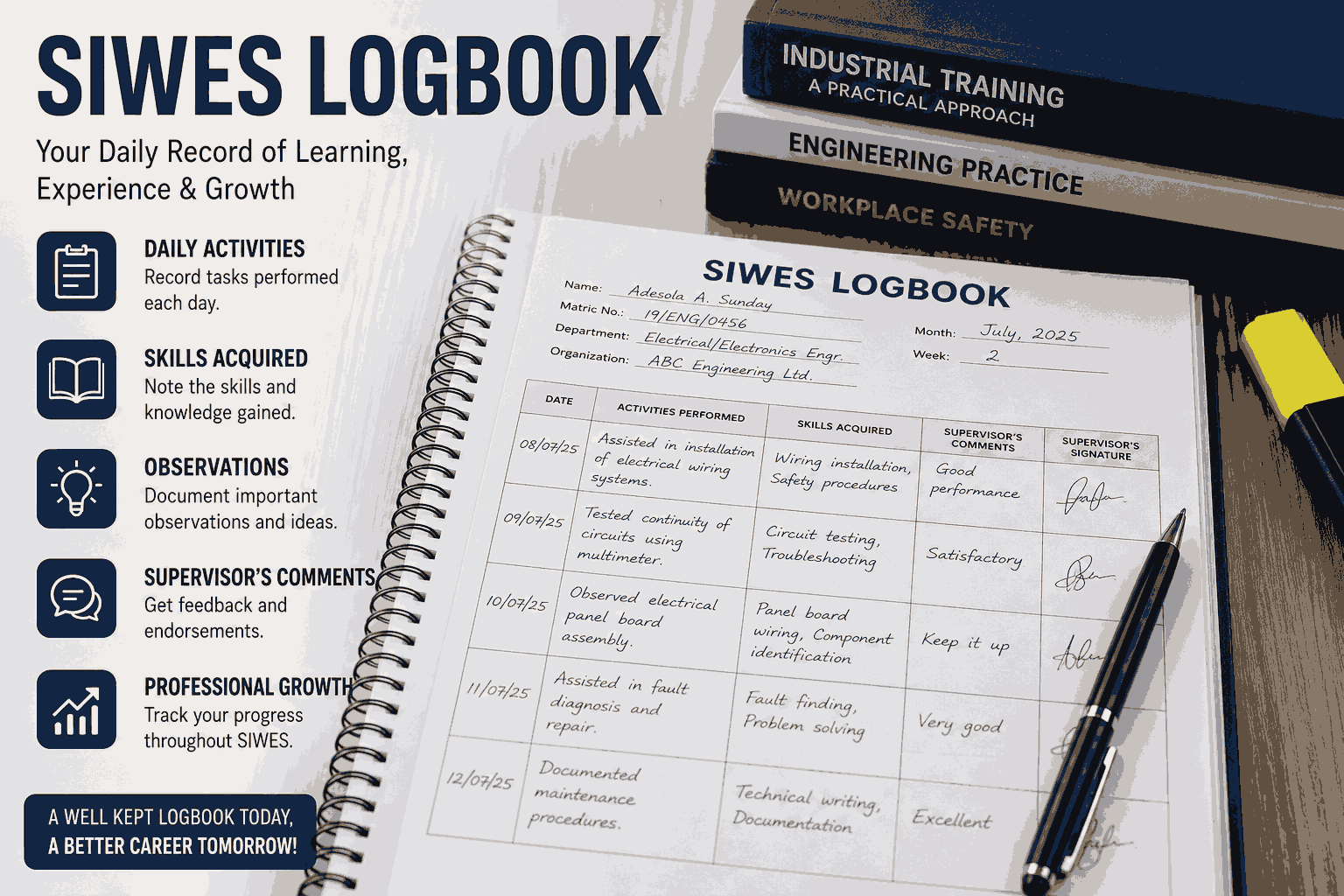
The SIWES logbook is one of the most important documents every student participating in the Students Industrial Work Experience Scheme (SIWES) must complete during industrial training. Whether you are studying engineering, science, technology, agriculture, education, management, or any related discipline, your SIWES logbook serves as official evidence of your daily activities, skills acquired, practical experiences, observations, and contributions during your attachment period.
Many students underestimate the importance of the SIWES logbook until the end of their training when supervisors, institutions, and Industrial Training Fund (ITF) officials request it for assessment. A properly completed SIWES logbook can significantly improve your SIWES evaluation, while an incomplete or poorly written logbook may affect your final score.
The primary purpose of the SIWES logbook is to document practical learning experiences. It bridges the gap between theoretical classroom knowledge and real-world workplace applications. Every entry in the SIWES logbook should accurately reflect the tasks performed, lessons learned, challenges encountered, and solutions applied throughout the training period.
In this comprehensive guide, you will learn everything about the SIWES logbook, including its purpose, importance, structure, daily entry format, common mistakes, assessment criteria, best practices, and tips for achieving excellent results.
What Is a SIWES Logbook?
Definition of a SIWES Logbook
A SIWES logbook is an official record book issued to students participating in the Students Industrial Work Experience Scheme. It is used to document daily, weekly, and monthly industrial training activities.
The SIWES logbook acts as a diary of practical learning experiences and serves as proof that the student actively participated in industrial training throughout the attachment period.
The information recorded in a SIWES logbook typically includes:
- Date of activity
- Department assigned
- Tasks performed
- Equipment used
- Skills acquired
- Supervisor’s comments
- Student observations
- Weekly endorsements
The SIWES logbook helps institutions assess whether students gained practical exposure relevant to their academic disciplines.
Understanding SIWES and Its Objectives
What Is SIWES?
The Students Industrial Work Experience Scheme (SIWES) is a skills acquisition program established by the Industrial Training Fund (ITF) in Nigeria.
The scheme was created to expose students to practical work environments before graduation. Through SIWES, students gain firsthand industry experience, develop employability skills, and understand workplace expectations.
More information about SIWES and industrial training can be found through:
- Industrial Training Fund (ITF): itf.gov.ng
- National Universities Commission (NUC): nuc.edu.ng
Objectives of SIWES
The major objectives include:
Bridging Theory and Practice
SIWES enables students to apply classroom knowledge in practical situations.
Developing Technical Skills
Students learn modern tools, equipment, technologies, and industry practices.
Improving Employability
The experience gained through SIWES makes graduates more attractive to employers.
Building Professional Relationships
Students interact with professionals and establish valuable industry networks.
Enhancing Problem-Solving Skills
Industrial training exposes students to real workplace challenges and solutions.
The SIWES logbook is essential in documenting these learning outcomes.
Importance of a SIWES Logbook
Evidence of Participation
A completed SIWES logbook serves as official evidence that a student attended and participated in industrial training activities.
Academic Assessment
Most institutions allocate marks specifically for the SIWES logbook.
Students who maintain detailed records often receive better evaluations.
Monitoring Progress
The SIWES logbook allows supervisors to track the student’s progress throughout the training period.
Professional Documentation
Maintaining a SIWES logbook teaches students how professionals document workplace activities.
Future Reference
A well-maintained SIWES logbook becomes a valuable reference when preparing reports, projects, resumes, and job interviews.
Components of a SIWES Logbook
Student Information Section
The first pages of a SIWES logbook usually contain:
- Student name
- Matriculation number
- Department
- Institution
- Training organization
- Duration of attachment
Employer Information
This section includes:
- Company name
- Company address
- Industry category
- Supervisor’s details
Daily Activity Pages
The daily pages form the core of the SIWES logbook.
Students are expected to record:
- Date
- Activities performed
- Equipment used
- Lessons learned
Weekly Summary Section
Many SIWES logbook formats include weekly summaries where students highlight key achievements.
Supervisor Endorsement Section
Industry supervisors review and sign entries periodically.
Institutional Supervisor Section
Academic supervisors may also review and endorse the SIWES logbook during visitation.
How to Fill a SIWES Logbook Correctly
Record Activities Daily
One of the most important rules of maintaining a SIWES logbook is consistency.
Do not wait until the end of the week or month before making entries.
Daily documentation improves accuracy.
Be Specific
Avoid vague statements such as:
“Worked in the office.”
Instead write:
“Assisted in preparing inventory records using Microsoft Excel and verified stock entries for accuracy.”
Use Professional Language
A SIWES logbook should contain clear and professional descriptions.
Avoid slang, abbreviations, or informal expressions.
Highlight Learning Outcomes
Each entry should explain what was learned.
For example:
“Learned the calibration process for digital weighing equipment.”
Obtain Signatures Regularly
Ensure supervisors sign the SIWES logbook weekly or according to company policy.
Sample SIWES Logbook Entries
Engineering Student Example
Date: 10 July 2025
Activities:
- Observed electrical panel installation.
- Assisted technicians in cable routing.
- Learned safety procedures for electrical maintenance.
Skills Acquired:
- Cable management.
- Electrical safety practices.
- Basic troubleshooting.
Supervisor’s Comment:
Satisfactory participation.
Computer Science Student Example
Date: 15 July 2025
Activities:
- Installed operating systems on workstations.
- Configured local network settings.
- Assisted in software updates.
Skills Acquired:
- System installation.
- Network configuration.
- Software maintenance.
Supervisor’s Comment:
Demonstrated excellent learning ability.
Business Administration Student Example
Date: 20 July 2025
Activities:
- Managed customer records.
- Processed invoices.
- Assisted with administrative documentation.
Skills Acquired:
- Office administration.
- Record management.
- Customer service.
Supervisor’s Comment:
Good performance.
Common Mistakes Students Make in a SIWES Logbook
Writing Entries Late
Many students postpone entries and later forget important details.
Copying Other Students
Every SIWES logbook should reflect individual experiences.
Copied entries can be detected during assessment.
Incomplete Records
Missing dates, activities, or signatures weaken the credibility of the SIWES logbook.
Poor Handwriting
Illegible writing may create difficulties during evaluation.
Lack of Technical Details
General statements provide little evidence of practical learning.
Missing Supervisor Endorsements
Unsigned entries may be considered invalid.
Tips for Writing an Excellent SIWES Logbook
Maintain Consistency
Update your SIWES logbook every working day.
Use Clear Descriptions
Describe tasks accurately and professionally.
Include Skills Learned
Always mention new knowledge gained.
Follow Workplace Terminology
Use industry-specific terms where appropriate.
Ask Questions
The more you learn, the richer your SIWES logbook becomes.
Keep It Neat
A clean and organized SIWES logbook creates a positive impression.
Review Entries Weekly
Regular reviews help identify missing information.
How Supervisors Assess a SIWES Logbook
Accuracy
Supervisors verify whether entries reflect actual workplace activities.
Completeness
A complete SIWES logbook contains consistent daily records.
Relevance
Activities recorded should relate to the student’s field of study.
Professional Presentation
Neatness, organization, and clarity influence assessment.
Learning Outcomes
Students must demonstrate growth and skill acquisition.
Benefits of Maintaining a High-Quality SIWES Logbook
Better Academic Scores
A properly completed SIWES logbook often contributes significantly to SIWES grades.
Easier Report Writing
The SIWES logbook provides information needed for preparing SIWES reports.
Improved Professional Development
Documentation strengthens observation and reporting skills.
Career Preparation
Students learn workplace accountability and record management.
Stronger Interview Performance
Experiences recorded in the SIWES logbook can be discussed during job interviews.
Relationship Between SIWES Logbook and SIWES Report
Many students confuse the SIWES logbook with the SIWES report.
The SIWES logbook contains daily records of activities performed during industrial training.
The SIWES report is a detailed academic document prepared after the training period. It summarizes experiences, findings, observations, challenges, recommendations, and conclusions.
A properly maintained SIWES logbook makes report writing easier because all activities have already been documented systematically.
Best Practices for Students During Industrial Training
Be Punctual
Arrive at work on time every day.
Observe Safety Procedures
Follow all workplace regulations.
Take Notes
Additional notes can improve the quality of your SIWES logbook.
Participate Actively
Seek opportunities to learn practical skills.
Build Relationships
Interact professionally with supervisors and colleagues.
Stay Curious
Ask relevant questions and seek clarification whenever necessary.
Digital Tools That Can Support SIWES Documentation
Although the official SIWES logbook is usually physical, students can use digital tools for note-taking and organization.
Useful tools include:
- Microsoft Word: microsoft.com/microsoft-365/word
- Google Docs: docs.google.com
- Microsoft Excel: microsoft.com/microsoft-365/excel
- Google Drive: drive.google.com
These tools can help students keep backup records before transferring information into the official SIWES logbook.
Challenges Students Face When Filling a SIWES Logbook
Limited Exposure
Some organizations assign repetitive tasks.
Lack of Supervision
Students may struggle to obtain regular feedback.
Time Constraints
Balancing work responsibilities and documentation can be difficult.
Technical Knowledge Gaps
Students sometimes encounter unfamiliar concepts.
The solution is to remain proactive, ask questions, and consistently update the SIWES logbook.
Conclusion
The SIWES logbook is far more than a simple record book. It is a vital academic and professional document that demonstrates participation, learning, growth, and practical experience during industrial training. A well-maintained SIWES logbook provides evidence of acquired skills, supports SIWES report preparation, improves academic assessment, and contributes to career development.
Students who update their SIWES logbook daily, record meaningful activities, obtain regular supervisor endorsements, and maintain professional documentation standards are more likely to achieve excellent results. By treating the SIWES logbook as an important professional document rather than a routine requirement, students can maximize the value of their industrial training experience and build a strong foundation for future careers.
Also Read: What Is the Salary of Level 7 in Nigeria? (2026 Updated Guide)
Frequently Asked Questions (FAQs)
1. How often should I update my SIWES logbook?
You should update your SIWES logbook every working day. Daily entries ensure accuracy and prevent forgetting important activities or lessons learned.
2. Can I fill my SIWES logbook at the end of the week?
While it may be possible, it is not advisable. Completing the SIWES logbook daily produces more accurate, detailed, and reliable records.
3. What happens if my SIWES logbook is incomplete?
An incomplete SIWES logbook may affect your assessment, reduce your SIWES score, and create difficulties during report writing and supervisor evaluation.















+ There are no comments
Add yours