







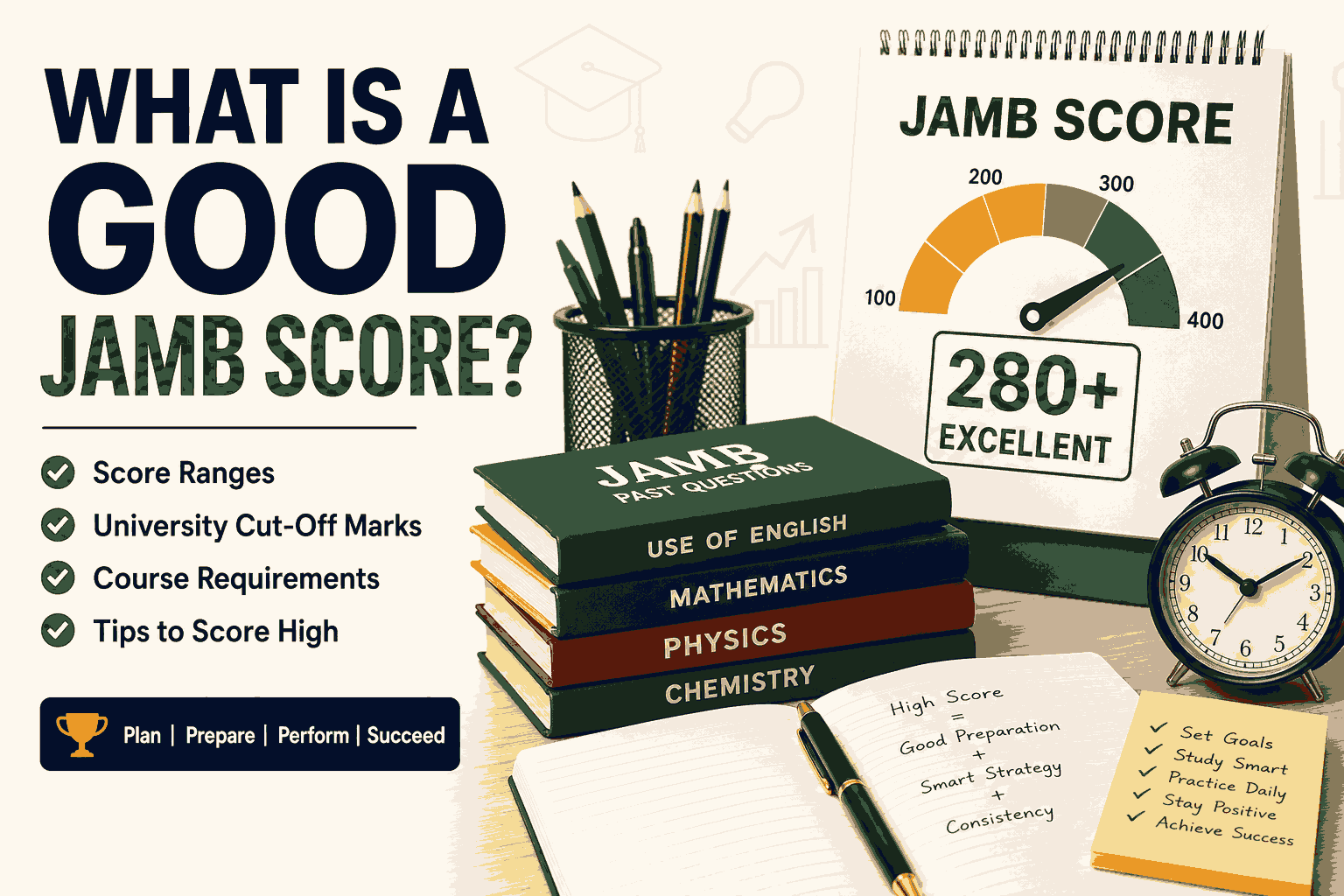
Every year, millions of Nigerian students sit for the examination conducted by the Joint Admissions and Matriculation Board, popularly known as JAMB. One of the biggest questions candidates ask after writing the exam is: “What is a good JAMB score?”
The truth is that there is no single answer that fits everyone. A good JAMB score depends on several factors including your chosen course, institution, level of competition, and admission policies. For some students, 180 may be enough. For others, even 280 may not guarantee admission.
In this detailed guide, you will learn what a good JAMB score means, the score ranges for different universities and courses, how schools determine cut-off marks, and practical tips to improve your chances of admission. If you are preparing for JAMB or already checking your result, this article will help you understand exactly where you stand.
Understanding the JAMB Scoring System
Before discussing what is a good JAMB score, it is important to understand how the scoring system works.
The JAMB Official Website conducts the Unified Tertiary Matriculation Examination (UTME) for candidates seeking admission into Nigerian universities, polytechnics, and colleges of education.
The examination is scored over 400 marks, divided across four subjects:
- Use of English (compulsory)
- Three other subjects related to your course
Each subject carries a maximum of 100 marks.
JAMB Score Breakdown
| Score Range | Meaning |
|---|---|
| 300 – 400 | Exceptional |
| 250 – 299 | Very Competitive |
| 200 – 249 | Good |
| 180 – 199 | Average |
| 160 – 179 | Below Average |
| Below 160 | Poor for most universities |
Understanding this table is the first step toward knowing what is a good JAMB score for your academic goals.
What Is a Good JAMB Score in Nigeria?
A good JAMB score is a score high enough to increase your chances of admission into your preferred institution and course.
In Nigeria today, a score of 200 and above is generally considered a good JAMB score for many universities. However, highly competitive courses and top federal universities often require much higher scores.
For example:
- Medicine may require 280+
- Law may require 250+
- Engineering may require 240+
- Nursing may require 260+
Meanwhile, some state universities and polytechnics may accept candidates with scores between 160 and 180.
So when asking “what is a good JAMB score,” you must also ask:
- Which school?
- Which course?
- How competitive is the admission process?
What Is a Good JAMB Score for Federal Universities?
Federal universities in Nigeria usually attract the highest number of applicants. As a result, they often have higher cut-off marks.
Some of the most competitive federal universities include:
- University of Lagos
- University of Ibadan
- Obafemi Awolowo University
- University of Nigeria
- Ahmadu Bello University
Recommended Scores for Federal Universities
| Course Type | Recommended Score |
|---|---|
| Medicine & Surgery | 280 – 320 |
| Law | 250 – 300 |
| Pharmacy | 260 – 300 |
| Engineering | 240 – 280 |
| Computer Science | 230 – 270 |
| Accounting | 220 – 260 |
| Education Courses | 180 – 220 |
If your dream school is a top federal university, then a good JAMB score should ideally be above 240.
What Is a Good JAMB Score for State Universities?
State universities are generally less competitive than federal institutions, though some are still highly selective.
Examples include:
- Lagos State University
- Ekiti State University
- Delta State University
- Osun State University
For many state universities:
- 180–220 may be acceptable
- Competitive courses may require 230+
Average Competitive Scores
| Course | Score |
|---|---|
| Nursing | 240+ |
| Mass Communication | 220+ |
| Accounting | 210+ |
| Political Science | 200+ |
| Sociology | 190+ |
A good JAMB score for a state university is usually between 200 and 250.
What Is a Good JAMB Score for Polytechnics and Colleges of Education?
Polytechnics and colleges of education generally have lower admission requirements compared to universities.
Popular polytechnics include:
- Yaba College of Technology
- Federal Polytechnic Ilaro
- The Polytechnic Ibadan
Most polytechnics accept:
- 120–180 for many courses
- 180+ for competitive departments
Colleges of education may accept:
- 100–160 depending on the program
So if your target is a polytechnic, a good JAMB score may start from 150 upward.
Courses That Require Very High JAMB Scores
Some courses in Nigeria are extremely competitive because many candidates apply for them every year.
Medicine and Surgery
Medicine remains one of the toughest courses to gain admission into.
A good JAMB score for Medicine is usually:
- 280–320
Top schools may require even more.
Law
Law is another competitive course.
Recommended score:
- 250–300
Nursing
Nursing has become highly competitive in recent years.
Recommended score:
- 250–290
Engineering
Engineering courses also require strong performance.
Recommended score:
- 230–280
Computer Science
Technology-related courses are now in high demand.
Recommended score:
- 220–270
If you are applying for any of these courses, your definition of what is a good JAMB score must be much higher than average.
Can You Gain Admission With a Low JAMB Score?
Yes, admission is still possible even with a lower score.
Many students believe their future is over after scoring below 200, but that is not always true.
Options include:
- Applying to less competitive schools
- Choosing less competitive courses
- Considering polytechnics
- Applying for part-time programs
- Taking JUPEB or pre-degree programs
Some institutions also consider:
- O’Level grades
- Post-UTME performance
- Catchment areas
- Educationally disadvantaged states
A score of 170 may not be enough for Medicine, but it could still secure admission into another program.
How Universities Determine Admission Cut-Off Marks
A school’s cut-off mark is not random. Several factors affect it.
1. Number of Applicants
If thousands apply for one course, the cut-off rises.
2. Student Performance
If candidates generally score high, schools increase cut-off marks.
3. Available Admission Slots
Courses with limited spaces become more competitive.
4. School Reputation
Top universities naturally attract more applicants.
5. Government Policies
The Joint Admissions and Matriculation Board sometimes sets minimum benchmark scores for institutions.
Difference Between JAMB Cut-Off Mark and Departmental Cut-Off Mark
Many students confuse these two terms.
JAMB Cut-Off Mark
This is the minimum score allowed for a candidate to participate in admission screening.
Example:
- 140
- 160
- 180
Departmental Cut-Off Mark
This is the actual score required for admission into a specific course.
Example:
- Medicine may require 290
- Law may require 270
- Accounting may require 240
This means a student may pass the general cut-off but still fail to gain admission into a competitive department.
That is why understanding what is a good JAMB score goes beyond basic eligibility.
How Post-UTME Affects Your Admission Chances
Some universities combine:
- JAMB score
- Post-UTME score
- O’Level performance
For example:
| Component | Percentage |
|---|---|
| JAMB | 50% |
| Post-UTME | 30% |
| O’Level | 20% |
A student with a moderate JAMB score can still gain admission by performing well in Post-UTME.
This is why students should never stop preparing after UTME.
What Is the Average JAMB Score in Nigeria?
In many years, the average JAMB score in Nigeria falls between:
- 160 and 190
This means candidates scoring above 200 are already above average.
Students scoring:
- 250+
- 280+
- 300+
are usually among the top-performing candidates nationwide.
So statistically speaking, a good JAMB score is anything significantly above the national average.
Best Strategies to Score High in JAMB
If you want a truly competitive score, preparation is essential.
1. Start Early
Avoid late preparation.
Students who begin reading months before the exam often perform better.
2. Use the JAMB Syllabus
The syllabus helps you focus only on relevant topics.
You can access it through the JAMB Portal.
3. Practice Past Questions
Past questions help you understand:
- Exam patterns
- Frequently repeated topics
- Time management
4. Study Daily
Consistency matters more than overnight reading.
5. Take CBT Practice Tests
Computer-based testing practice improves speed and confidence.
6. Improve English Language
Since Use of English is compulsory, strong comprehension skills can significantly increase your score.
7. Avoid Examination Malpractice
Malpractice can lead to:
- Result cancellation
- Admission disqualification
- Future academic problems
Common Myths About JAMB Scores
“A Score Below 200 Means Failure”
False.
Many students gain admission yearly with scores below 200.
“300 Guarantees Admission”
Not always.
Admission depends on:
- Post-UTME
- O’Level
- Quota system
- Competition
“Private Universities Accept Any Score”
Most private universities still require acceptable scores and O’Level qualifications.
Examples include:
- Covenant University
- Babcock University
How to Check Your JAMB Result
Candidates can check results through:
- SMS
- JAMB portal
Official result-checking platform:
Always avoid fake websites claiming to upgrade scores or manipulate results.
What Is a Good JAMB Score for Scholarship Opportunities?
Scholarship opportunities usually favor candidates with excellent academic records.
For merit-based scholarships:
- 250+ is often competitive
- 280+ greatly improves chances
High scores may also qualify students for:
- Federal scholarships
- State government scholarships
- Institutional awards
Psychological Impact of JAMB Scores
Many students experience anxiety after seeing their scores.
However, a score should not define your intelligence or future potential.
Some successful people:
- changed courses,
- changed institutions,
- or rewrote JAMB before succeeding academically.
The important thing is understanding your options and making informed decisions.
The Future of JAMB and University Admissions in Nigeria
The Nigerian education system continues to evolve.
Possible future developments include:
- Improved CBT systems
- Stronger anti-malpractice measures
- AI-assisted examination monitoring
- Flexible admission processes
The Joint Admissions and Matriculation Board has already introduced several digital improvements in recent years.
Students should therefore stay updated through official channels only.
Conclusion
So, what is a good JAMB score?
The answer depends on your goals, institution, and course of study. Generally:
- 200+ is considered good,
- 250+ is highly competitive,
- and 300+ is exceptional.
However, admission is never determined by JAMB score alone. Post-UTME performance, O’Level grades, school policies, and course competition all play important roles.
Instead of comparing yourself with others, focus on choosing the best path that aligns with your academic ambitions. Whether your score is high or average, there are still opportunities available if you make smart decisions and stay determined.
Also Read: Can I Write JAMB While in University? Everything You Need to Know in Nigeria
Frequently Asked Questions (FAQs)
1. Is 180 a good JAMB score?
Yes, 180 is considered an average score and may be enough for some state universities, polytechnics, and colleges of education. However, it may not be competitive for highly demanded courses.
2. Can I study Medicine with 250 in JAMB?
It depends on the university. Some schools may consider 250, but top federal universities usually require scores closer to 280 or above for Medicine.
3. What is the best JAMB score possible?
The highest possible JAMB score is 400. Scores above 300 are considered exceptional and place candidates among the top performers nationwide.
















+ There are no comments
Add yours