






When preparing for the West African Examinations Council (WAEC) examination, one of the most common questions students ask is: How many subjects do you need in WAEC? Understanding the number of subjects required in WAEC is important because it determines your eligibility for admission into universities, polytechnics, colleges of education, and various employment opportunities.
Many students are confused about the exact number of subjects they should register, pass, or combine for admission purposes. Some believe passing five subjects is enough, while others think they must pass all registered subjects. The truth lies somewhere in between, depending on your educational goals and career aspirations.
In this comprehensive guide, we will explain how many subjects do you need in WAEC, the minimum requirements for admission, compulsory subjects, recommended subject combinations, and everything else you need to know to succeed.
Understanding WAEC
The West African Examinations Council (WAEC) is an examination body established to conduct standardized examinations in English-speaking West African countries including Nigeria, Ghana, Sierra Leone, Liberia, and The Gambia.
WAEC administers the West African Senior School Certificate Examination (WASSCE), which serves as proof that a student has completed secondary school education.
Every year, millions of students sit for WAEC examinations to qualify for higher education and employment opportunities.
How Many Subjects Do You Need in WAEC?
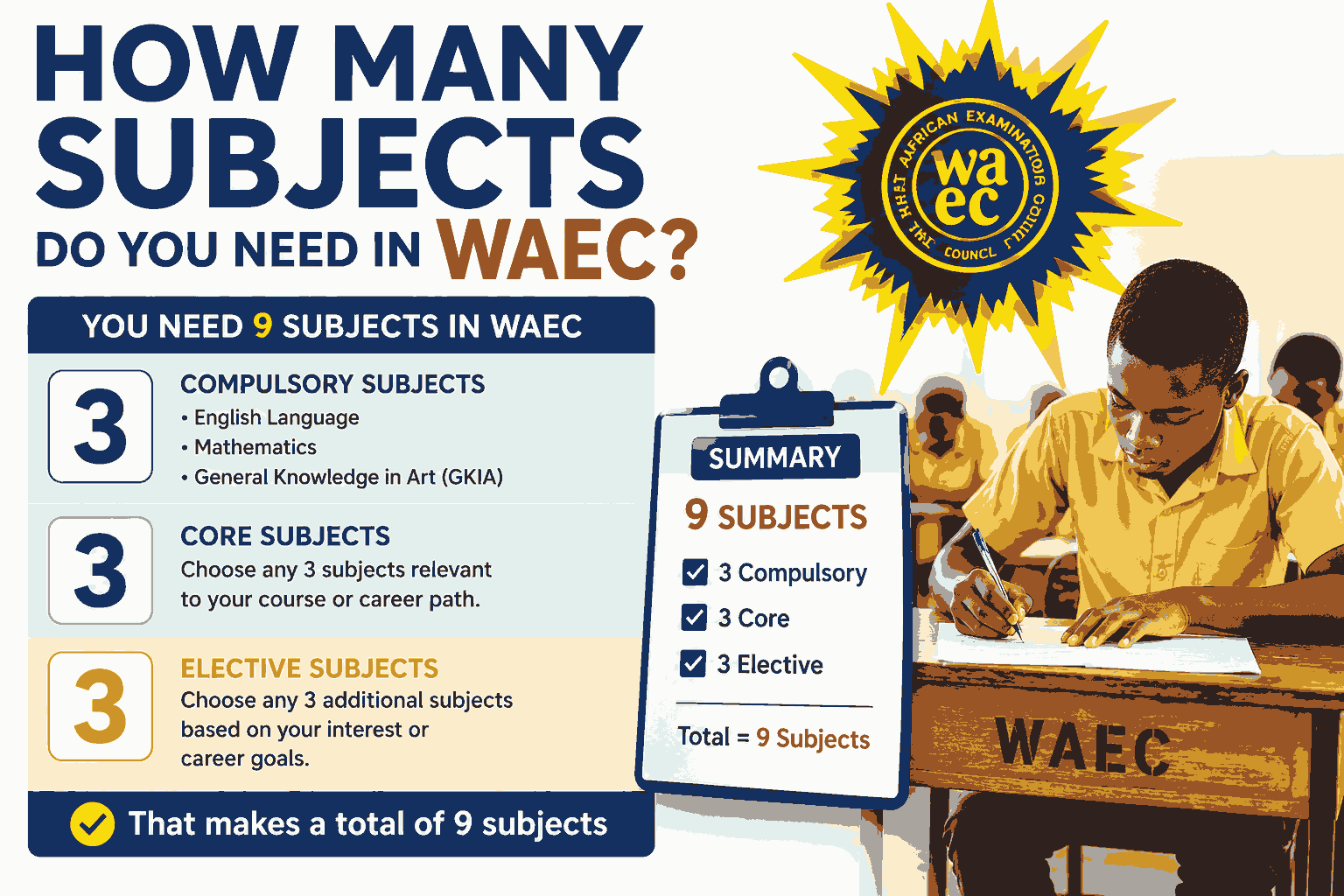
The direct answer to the question “How many subjects do you need in WAEC?” is that students are generally required to register for a minimum of eight (8) subjects and a maximum of nine (9) subjects.
According to WAEC guidelines, candidates must offer a combination of compulsory and elective subjects based on their field of study.
Minimum Number of Subjects
A candidate must register for at least:
- 8 subjects
Maximum Number of Subjects
A candidate can register for:
- Up to 9 subjects
This means the standard answer to how many subjects do you need in WAEC is between 8 and 9 subjects.
Compulsory Subjects Every WAEC Candidate Must Offer
Regardless of whether you are a science, commercial, or arts student, there are certain compulsory subjects every candidate must take.
These subjects include:
- English Language
- Mathematics
- Civic Education
- One Nigerian Language (where applicable)
- One Trade Subject (depending on school requirements)
English Language and Mathematics are particularly important because most tertiary institutions in Nigeria require credit passes in both subjects.
When discussing how many subjects do you need in WAEC, these compulsory subjects form the foundation of your registration.
Why Are Five Credits Important?
Although students register for 8 or 9 subjects, most universities focus on five key credit passes.
The famous requirement is:
Five Credits Including English and Mathematics
For admission into Nigerian universities, candidates typically need:
- At least five credit passes
- English Language
- Mathematics
- Three other relevant subjects related to the chosen course
This is why many people become confused when asking how many subjects do you need in WAEC.
While you register for 8 or 9 subjects, institutions often require only five relevant credits for admission.
WAEC Subject Requirements for Science Students
Science students usually register for the following subjects:
Core Subjects
- English Language
- Mathematics
- Civic Education
Science Subjects
- Physics
- Chemistry
- Biology
Additional Subjects
- Agricultural Science
- Further Mathematics
- Computer Studies
A typical science student therefore offers 8 or 9 subjects.
If your goal is Medicine, Pharmacy, Nursing, Engineering, or Computer Science, understanding how many subjects do you need in WAEC becomes crucial because universities pay close attention to science-related credits.
WAEC Subject Requirements for Commercial Students
Commercial students usually register for:
- English Language
- Mathematics
- Civic Education
- Economics
- Financial Accounting
- Commerce
- Marketing
- Government
- Geography
For commercial students, the answer to how many subjects do you need in WAEC remains the same—between 8 and 9 subjects.
These subjects prepare candidates for courses such as:
- Accounting
- Business Administration
- Banking and Finance
- Economics
- Marketing
WAEC Subject Requirements for Arts Students
Arts students generally register for:
- English Language
- Mathematics
- Civic Education
- Literature in English
- Government
- Christian Religious Studies (CRS) or Islamic Religious Studies (IRS)
- History
- Economics
- Yoruba, Igbo, or Hausa
Again, the answer to how many subjects do you need in WAEC for arts students is usually 8 or 9 subjects.
These subjects support admission into courses like:
- Law
- Mass Communication
- English
- Political Science
- International Relations
Can You Gain Admission with Five Subjects?
A common misconception is that students only need five subjects in WAEC.
The reality is different.
You register for 8 or 9 subjects, but universities generally require:
- Five credit passes
- Relevant subject combinations
- English Language
- Mathematics (for most courses)
Therefore, when asking how many subjects do you need in WAEC, it is important to distinguish between:
Subjects Registered
8–9 subjects
Subjects Required for Admission
Five relevant credits
This distinction helps students understand admission requirements better.
What Grades Are Considered Credits in WAEC?
WAEC grades are interpreted as follows:
| Grade | Meaning |
|---|---|
| A1 | Excellent |
| B2 | Very Good |
| B3 | Good |
| C4 | Credit |
| C5 | Credit |
| C6 | Credit |
| D7 | Pass |
| E8 | Pass |
| F9 | Fail |
For admission purposes, universities usually accept:
- A1
- B2
- B3
- C4
- C5
- C6
Therefore, obtaining five credits means earning at least a C6 in five required subjects.
Can You Combine WAEC Results?
Yes.
Students who do not obtain the required credits in one sitting can combine results from:
- WAEC and WAEC
- WAEC and NECO
- WAEC and NABTEB (depending on institution)
This option helps candidates who are worried about how many subjects do you need in WAEC and whether they can make up deficiencies later.
However, some competitive courses may prefer one sitting.
Always verify the admission requirements of your chosen institution.
What Happens If You Fail Mathematics or English?
Failing English Language or Mathematics can create challenges.
Many institutions require credits in both subjects.
If a candidate fails either subject, they may:
- Rewrite WAEC
- Sit for NECO
- Take GCE examinations
Since English and Mathematics are core subjects, they remain central when considering how many subjects do you need in WAEC for university admission.
Best Subject Combination for Popular Courses
Medicine and Surgery
Required subjects:
- English Language
- Mathematics
- Biology
- Chemistry
- Physics
Engineering
Required subjects:
- English Language
- Mathematics
- Physics
- Chemistry
- Further Mathematics (advantage)
Law
Required subjects:
- English Language
- Literature in English
- Government
- CRS/IRS
- Any Arts Subject
Accounting
Required subjects:
- English Language
- Mathematics
- Economics
- Financial Accounting
- Commerce
Choosing the correct subjects is just as important as understanding how many subjects do you need in WAEC.
Tips for Passing WAEC Successfully
Start Early
Avoid waiting until examination periods before studying.
Create a Study Timetable
Allocate sufficient time to each subject.
Practice Past Questions
Past questions help students understand examination patterns.
Focus on Weak Subjects
Spend more time improving difficult subjects.
Attend Classes Regularly
Consistent attendance improves understanding.
Use Recommended Textbooks
Read materials approved by teachers and examination bodies.
Join Study Groups
Group discussions can improve learning and retention.
These strategies significantly increase your chances of earning the credits needed after registering the required number of subjects.
Common Mistakes Students Make During WAEC Registration
Some students encounter problems because they:
- Choose wrong subject combinations
- Register fewer subjects than recommended
- Ignore admission requirements
- Neglect English and Mathematics
- Depend solely on examination malpractice
Understanding how many subjects do you need in WAEC helps students avoid these costly mistakes.
Why Universities Require Five Credits
Universities use five-credit requirements because they indicate a minimum level of academic competence.
These credits demonstrate that a student possesses:
- Basic literacy skills
- Numerical ability
- Subject-specific knowledge
- Academic readiness
Although WAEC candidates register for 8 or 9 subjects, universities focus on relevant credits when considering admission applications.
Frequently Asked Questions (FAQs)
1. How many subjects do you need in WAEC to gain admission?
You generally need five credit passes including English Language and Mathematics plus relevant subjects for your chosen course. However, candidates usually register for 8 or 9 subjects in WAEC.
2. Can I register only five subjects in WAEC?
No. WAEC typically requires candidates to register between 8 and 9 subjects, depending on school regulations and curriculum requirements.
3. Is Mathematics compulsory in WAEC?
Yes. Mathematics is one of the core subjects required by WAEC and is also a major admission requirement for most tertiary institutions in Nigeria.
Also Read: What Grade Is 55 in WAEC? Complete Guide to WAEC Grading System and Score Interpretation
Conclusion
So, how many subjects do you need in WAEC? The official requirement is that candidates usually register for 8 to 9 subjects. However, for university admission, most institutions require at least five credit passes, including English Language and Mathematics alongside relevant subjects for the chosen course.
Understanding the difference between subjects registered and credits required for admission can help students plan effectively and avoid unnecessary mistakes. Whether you are a science, commercial, or arts student, choosing the right subjects and aiming for strong grades will significantly improve your chances of gaining admission into your preferred institution.
Ultimately, success in WAEC is not determined by the number of subjects you register but by the quality of your performance in those subjects. Proper preparation, discipline, and consistency remain the keys to achieving excellent results.










+ There are no comments
Add yours