






If you are preparing for the West African Senior School Certificate Examination (WAEC), one of the most common questions you may ask is: How many subjects do I need to write in WAEC?
Understanding the correct number of subjects required is extremely important because choosing too few or the wrong combination can affect your chances of gaining admission into a university, polytechnic, college of education, or other higher institutions.
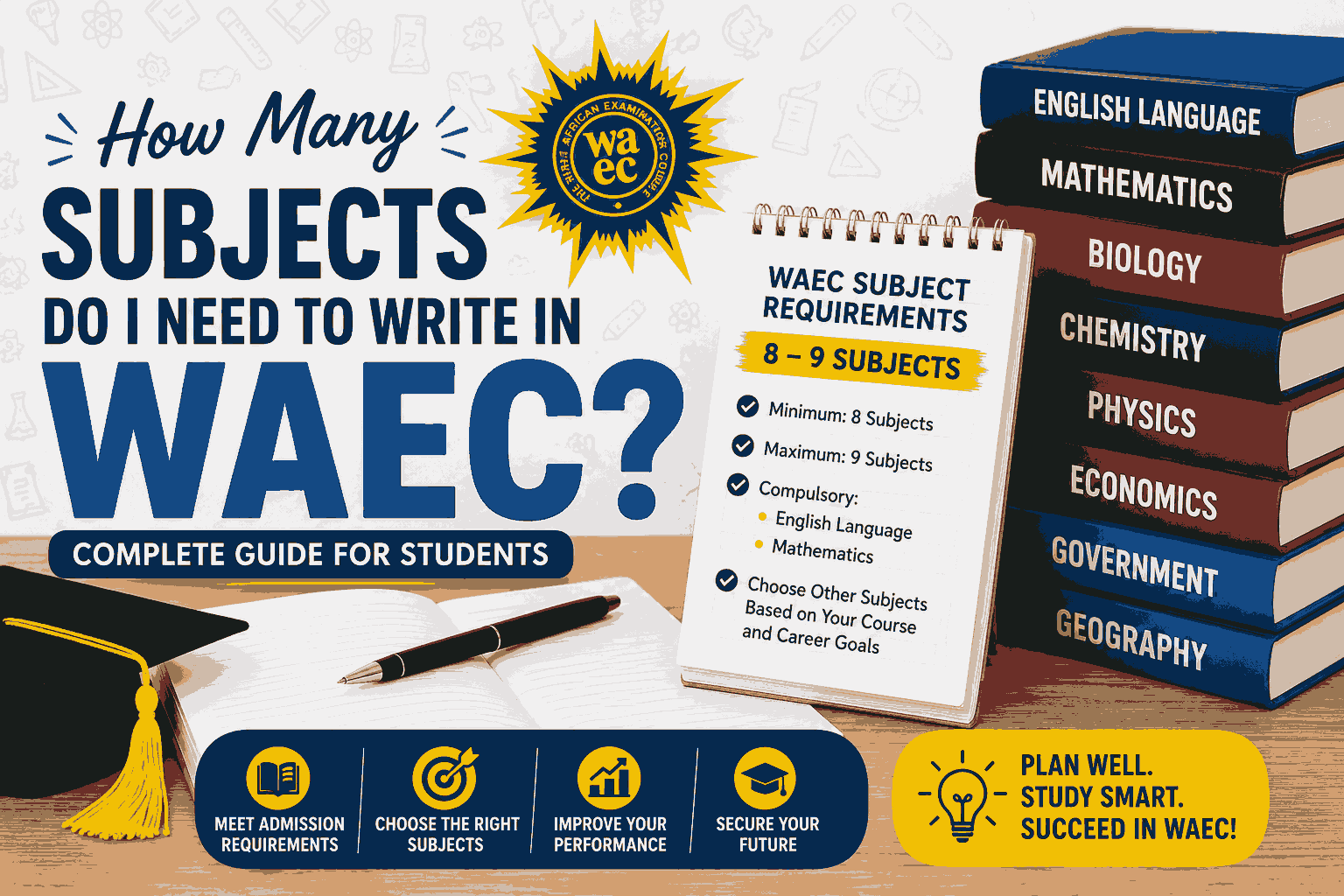
The simple answer is that WAEC candidates are required to register and sit for a minimum of eight (8) subjects and a maximum of nine (9) subjects. This requirement is stated by the official West African Examinations Council (WAEC) for WASSCE candidates.
However, there is much more you need to know beyond the number of subjects. Your subject combination, compulsory subjects, course requirements, and admission goals all play a major role in determining the best subjects to register.
This detailed guide explains everything you need to know about how many subjects do I need to write in WAEC, including subject combinations for Science, Art, and Commercial students, admission requirements, common mistakes, and expert tips.
Understanding WAEC Subject Requirements
Many students believe they can simply choose any subjects they like during registration. Unfortunately, that is not how WAEC works.
WAEC has specific guidelines that determine the minimum and maximum number of subjects candidates can register for.
According to WAEC regulations, candidates must register for:
- Minimum of 8 subjects
- Maximum of 9 subjects
The subjects must include compulsory core subjects and other electives related to the student’s field of study.
This means that if you are asking, how many subjects do I need to write in WAEC, the official answer is between 8 and 9 subjects.
Why Does WAEC Require 8 to 9 Subjects?
WAEC requires students to register multiple subjects because secondary education covers a broad curriculum.
The objective is to ensure students possess knowledge in:
- Language studies
- Mathematics
- Sciences
- Humanities
- Vocational studies
- Commercial subjects
This balanced structure helps students develop academically before proceeding to higher education.
Universities and other tertiary institutions also rely on WAEC results to determine whether students have met the necessary entry requirements.
Therefore, registering the correct number of subjects is not only a WAEC requirement but also an admission requirement.
Compulsory Subjects Every WAEC Candidate Must Write
When discussing how many subjects do I need to write in WAEC, it is important to understand that some subjects are compulsory.
For candidates sitting WASSCE in 2026 and 2027, WAEC indicates that the currently available core subjects include:
- English Language
- General Mathematics
Candidates then select six or seven additional subjects to make up the required minimum of eight subjects.
These compulsory subjects are especially important because most Nigerian universities require credits in:
- English Language
- Mathematics
Without credits in these subjects, gaining admission may become difficult regardless of performance in other areas.
How Many Subjects Do I Need to Write in WAEC for University Admission?
This is where many students become confused.
Although WAEC requires a minimum of eight subjects, universities generally focus on:
- Five credit passes
- Relevant subjects for your course
- English Language
- Mathematics
For example:
Medicine and Surgery
A student pursuing Medicine may require credits in:
- English Language
- Mathematics
- Biology
- Chemistry
- Physics
Engineering
An Engineering candidate may require:
- English Language
- Mathematics
- Physics
- Chemistry
- Further Mathematics (in some cases)
Law
A Law candidate may require:
- English Language
- Literature-in-English
- Government
- CRS/IRS
Therefore, when asking how many subjects do I need to write in WAEC, you should also ask:
“Which subjects are required for my intended course?”
Your subject combination is just as important as the number of subjects.
WAEC Subject Combination for Science Students
Science students typically register the maximum number of subjects because many science-related courses require several science credits.
A common science subject combination includes:
- English Language
- Mathematics
- Biology
- Chemistry
- Physics
- Geography
- Agricultural Science
- Economics
- Civic or another approved subject
Science students aiming for competitive courses such as Medicine, Pharmacy, Nursing, Medical Laboratory Science, Engineering, and Computer Science should ensure they include the required science subjects.
A poor subject combination can affect admission opportunities even if grades are excellent.
Best WAEC Subjects for Medical Students
Students planning to study Medicine should consider:
- English Language
- Mathematics
- Biology
- Chemistry
- Physics
- Economics
- Geography
- Agricultural Science
- Another approved subject
The most critical subjects remain Biology, Chemistry, and Physics.
Best WAEC Subjects for Engineering Students
Engineering candidates should prioritize:
- English Language
- Mathematics
- Physics
- Chemistry
- Further Mathematics
- Geography
- Technical Drawing
- Economics
- Another approved subject
Technical Drawing and Further Mathematics may provide additional advantages depending on the institution.
WAEC Subject Combination for Commercial Students
Commercial students have different academic requirements.
A typical commercial subject combination includes:
- English Language
- Mathematics
- Economics
- Accounting
- Commerce
- Government
- Geography
- Marketing
- Another approved subject
This combination supports courses such as:
- Accounting
- Banking and Finance
- Business Administration
- Marketing
- Economics
- Insurance
Students interested in professional accounting careers should pay particular attention to Accounting and Economics.
WAEC Subject Combination for Art Students
Art students also need to select subjects that align with their intended courses.
Common combinations include:
- English Language
- Mathematics
- Literature-in-English
- Government
- CRS or IRS
- History
- Economics
- Civic-related subject
- Another approved subject
This combination is suitable for courses such as:
- Law
- Mass Communication
- International Relations
- Political Science
- English
- Theatre Arts
Best WAEC Subjects for Law Students
Students intending to study Law should include:
- English Language
- Literature-in-English
- Government
- CRS or IRS
- Economics
- Mathematics
- History
- Other approved subjects
Literature-in-English is especially important because many universities require it.
Can I Write Only 7 Subjects in WAEC?
Many students ask this question every year.
For school candidates, WAEC regulations require candidates to sit for a minimum of eight subjects. Therefore, registering only seven subjects generally does not satisfy the standard WASSCE school candidate requirement.
To avoid registration problems, students should always confirm their subject selection with their school and WAEC guidelines.
When in doubt, consult the official WAEC website:
Can I Write 8 Subjects Instead of 9?
Yes.
In fact, many students successfully gain admission with eight subjects.
WAEC allows candidates to register between eight and nine subjects. Therefore, writing eight subjects is perfectly acceptable.
However, some students prefer nine subjects because:
- It provides a backup subject.
- It increases flexibility.
- One weak performance may have less impact.
- Universities can consider stronger grades.
If you are academically strong and your eight subjects already satisfy your course requirements, there may be no need to add an unnecessary ninth subject.
What Happens If I Fail One Subject?
Failing one subject does not automatically mean failure in WAEC.
The impact depends on:
- Which subject was failed
- Your intended course
- Admission requirements
For example:
If a student earns:
- English – Credit
- Mathematics – Credit
- Biology – Credit
- Chemistry – Credit
- Physics – Credit
- Economics – Credit
- Geography – Pass
- Government – Fail
The student may still qualify for many science-related courses.
However, failing English or Mathematics can create significant admission challenges.
That is why students should focus heavily on these core subjects.
How Many Subjects Do I Need to Pass in WAEC?
Another common question is not just how many subjects do I need to write in WAEC, but also how many subjects need to be passed.
For most university admissions, candidates need:
- At least five credits
- Relevant subjects
- English Language
- Mathematics
The exact requirements vary by institution and course.
Highly competitive programs may require six, seven, or more credits.
Therefore, students should aim beyond the minimum requirement and strive for strong overall performance.
Common Mistakes Students Make During WAEC Registration
Choosing Subjects Without Considering Future Courses
Many students select subjects based on what friends choose.
This is a major mistake.
Always check university requirements before registration.
Ignoring Compulsory Subjects
Some students focus heavily on electives and neglect English or Mathematics.
This can negatively affect admission opportunities.
Registering Too Many Difficult Subjects
While WAEC permits up to nine subjects, registering subjects you are not prepared for can increase pressure and reduce performance.
Not Confirming Subject Combinations
Every student should verify subject combinations with teachers, counselors, or admission guides before final registration.
Tips for Choosing the Right WAEC Subjects
1. Know Your Career Goal
Decide what you want to study after secondary school.
2. Research Admission Requirements
Visit the websites of universities you are interested in.
Popular institutions include:
3. Consult Your Teachers
Teachers understand subject combinations and can guide you properly.
4. Balance Difficulty Levels
Choose subjects that align with your strengths and future goals.
5. Focus on Core Subjects
English Language and Mathematics remain among the most important subjects for admission purposes.
Also Read: How Much Is a WAEC Certificate Online?
Frequently Asked Questions About How Many Subjects Do I Need to Write in WAEC
1: How many subjects do I need to write in WAEC?
WAEC candidates are required to register and sit for a minimum of eight (8) subjects and a maximum of nine (9) subjects.
2: Can I gain admission with 8 WAEC subjects?
Yes. Eight subjects are acceptable as long as you obtain the required credits for your chosen course and institution.
3: Is 9 subjects better than 8 in WAEC?
Not necessarily. Nine subjects provide additional flexibility, but what matters most is obtaining good grades in the subjects required for your intended course.
Conclusion
If you have been asking how many subjects do I need to write in WAEC, the official answer is straightforward: WAEC requires candidates to register and sit for a minimum of 8 subjects and a maximum of 9 subjects.
However, success in WAEC is not determined solely by the number of subjects you write. Your subject combination, grades, and alignment with your future course of study are equally important.
Whether you are a Science, Commercial, or Art student, ensure that your WAEC subjects match your career goals and university admission requirements. Focus on securing strong credits, especially in English Language and Mathematics, and choose subjects that support your future ambitions.
By selecting the right combination and preparing effectively, you can maximize your chances of gaining admission and achieving academic success.










+ There are no comments
Add yours