






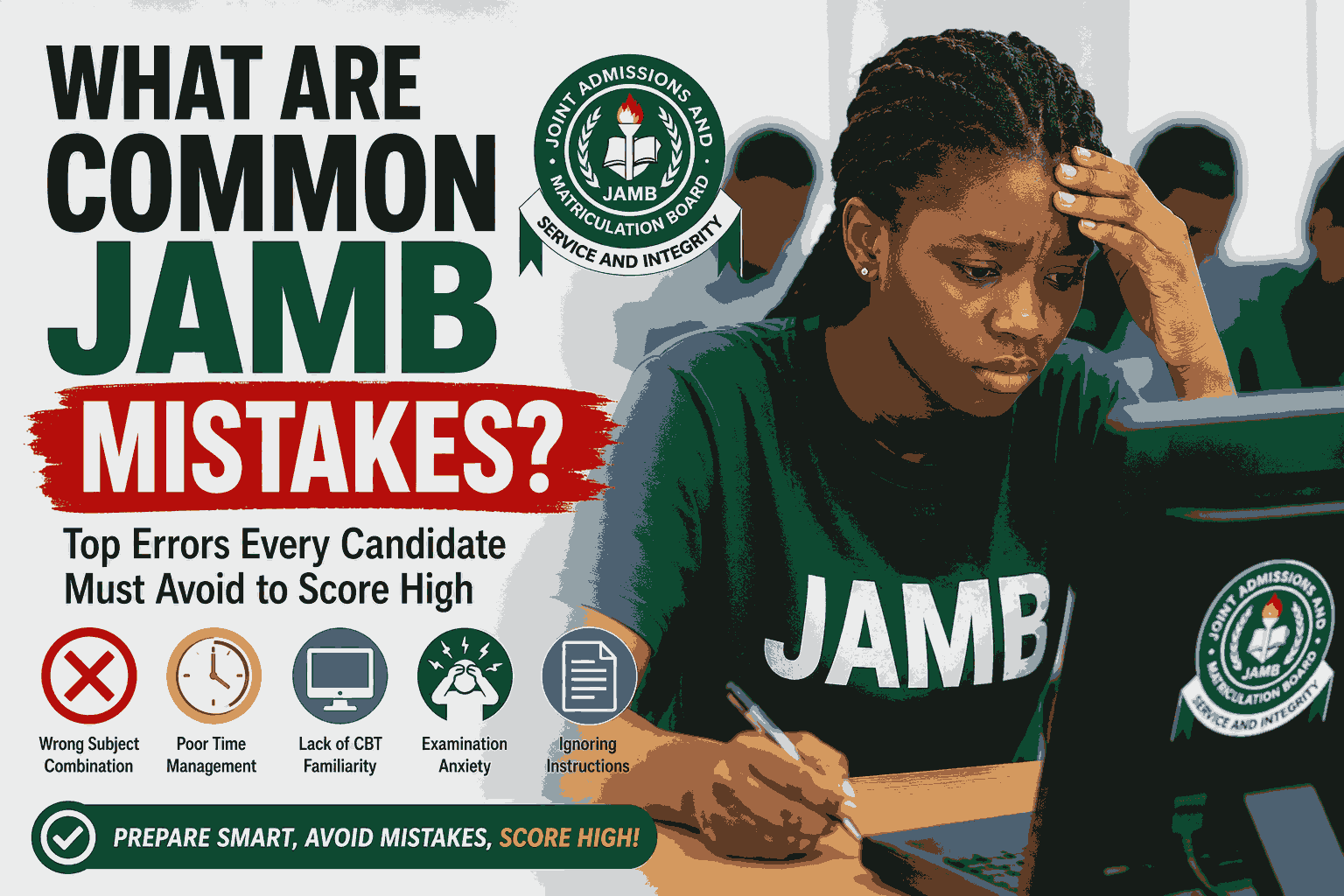
Every year, thousands of candidates sit for the Joint Admissions and Matriculation Board (JAMB) examination with hopes of gaining admission into their preferred institutions. Unfortunately, many students fail to achieve their desired scores not because they are unintelligent, but because they make avoidable errors before, during, and after the examination. If you have ever asked yourself, what are common JAMB mistakes, you are not alone. Understanding these mistakes can significantly improve your chances of success.
The question what are common JAMB mistakes is one that every candidate should answer before registering for the examination. Many students spend months studying but still perform poorly because they overlook critical details that affect their overall performance. By learning from the experiences of previous candidates, you can avoid costly errors and approach the examination with confidence.
In this comprehensive guide, we will discuss what are common JAMB mistakes, why they occur, how they affect candidates, and practical ways to avoid them. Whether you are a first-time candidate or a repeat applicant, this article will help you prepare smarter and increase your chances of securing admission.
Understanding the Importance of Avoiding JAMB Mistakes
Before diving into what are common JAMB mistakes, it is important to understand why avoiding these errors matters. JAMB is highly competitive, and even a small mistake can have significant consequences.
Many universities, polytechnics, and colleges of education use JAMB scores as a major criterion for admission. Therefore, every mark counts. A simple error such as choosing the wrong subject combination or mismanaging your time during the examination can reduce your score and affect your admission chances.
Candidates who understand what are common JAMB mistakes are better prepared to navigate the registration process, examination day, and admission procedures successfully.
Common JAMB Registration Mistakes
Choosing the Wrong Course
One of the biggest answers to the question what are common JAMB mistakes is selecting a course without proper research.
Many candidates choose courses based on peer pressure, family influence, or trends rather than personal interests and strengths. This often leads to disappointment when admission requirements are not met.
Before selecting a course, candidates should:
- Research career opportunities.
- Understand admission requirements.
- Assess their strengths and interests.
- Consult academic counselors if necessary.
Selecting the Wrong Institution
Another common mistake is choosing an institution without understanding its admission policies.
Some universities have higher cut-off marks than others. Candidates often discover too late that their chosen institution requires scores beyond their capability.
Always review admission requirements through the official JAMB website and the institution’s admission portal before making a decision.
Wrong Subject Combination
When discussing what are common JAMB mistakes, wrong subject combination ranks among the most damaging errors.
Each course requires specific subjects. For example, a student interested in Engineering may need Mathematics, Physics, Chemistry, and English.
Selecting incorrect subjects can make a candidate ineligible for admission even with a high JAMB score.
Poor Preparation Habits That Affect Performance
Starting Preparation Late
Many students underestimate the examination and begin preparation a few weeks before the test.
One major reason people search for what are common JAMB mistakes is because they realize too late that poor preparation affected their results.
Effective preparation should begin months before the examination date.
Benefits of early preparation include:
- Better understanding of topics.
- Reduced examination anxiety.
- More time for revision.
- Increased confidence.
Ignoring the JAMB Syllabus
The JAMB syllabus is a valuable resource that outlines topics candidates should study.
Many students read random materials without consulting the syllabus, resulting in wasted effort and missed topics.
The official syllabus helps candidates focus on relevant areas and maximize study efficiency.
Not Using Past Questions
Past questions provide insight into examination patterns and frequently tested topics.
Candidates who fail to practice past questions often struggle to adapt to the examination format.
Studying past questions helps candidates:
- Improve speed.
- Understand question patterns.
- Identify strengths and weaknesses.
- Build confidence.
Technology-Related Mistakes During CBT Exams
Lack of Computer Familiarity
JAMB is conducted through Computer-Based Testing (CBT).
A major answer to what are common JAMB mistakes is failing to learn basic computer operations before examination day.
Some candidates spend valuable time learning how to use a mouse during the examination.
Candidates should practice:
- Clicking options.
- Navigating screens.
- Submitting answers.
- Using CBT simulation software.
Panic During Technical Issues
Technical challenges occasionally occur during CBT examinations.
Candidates who panic often make poor decisions or lose concentration.
Remain calm and immediately notify examination officials if any issue arises.
Time Management Mistakes in JAMB
Spending Too Much Time on Difficult Questions
One of the most common answers to what are common JAMB mistakes is poor time management.
Many candidates spend several minutes trying to solve one difficult question while easier questions remain unanswered.
A smarter strategy is:
- Answer easy questions first.
- Skip difficult questions temporarily.
- Return later if time permits.
Failing to Monitor Time
Candidates sometimes become so focused on answering questions that they lose track of time.
Monitoring your remaining time throughout the examination helps ensure all questions receive attention.
Examination Day Mistakes Candidates Make
Arriving Late at the CBT Centre
Late arrival is one of the most avoidable mistakes candidates make.
Traffic, transportation problems, or poor planning can cause delays.
Candidates should:
- Visit the centre beforehand if possible.
- Leave home early.
- Prepare examination materials the previous day.
Forgetting Essential Documents
Another answer to what are common JAMB mistakes is arriving without required documents.
Important documents include:
- JAMB registration slip.
- Examination slip.
- Valid identification if required.
Failure to present necessary documents can create unnecessary stress.
Sleeping Late Before the Examination
Many students stay awake all night reading.
While this may seem productive, sleep deprivation negatively affects concentration, memory, and decision-making.
Adequate rest improves performance and alertness.
Psychological Mistakes That Reduce Scores
Examination Anxiety
Fear and anxiety can significantly impact performance.
Many well-prepared students underperform because nervousness affects their concentration.
To manage anxiety:
- Practice regularly.
- Maintain positive thinking.
- Get adequate sleep.
- Arrive early at the examination centre.
Comparing Yourself to Others
Some candidates become discouraged when they hear about other students’ preparation levels.
Everyone learns differently.
Focus on your preparation rather than comparing yourself to others.
Negative Mindset
Believing you will fail can become a self-fulfilling prophecy.
Confidence, preparation, and determination play major roles in examination success.
Academic Mistakes That Cost Valuable Marks
Guessing Excessively
While educated guesses can be useful, random guessing often leads to poor outcomes.
Candidates should eliminate obviously incorrect options before making a choice.
Failure to Read Instructions
A surprising answer to what are common JAMB mistakes is simply not reading instructions carefully.
Instructions explain:
- Number of questions.
- Time allocation.
- Answer procedures.
- Examination rules.
Ignoring instructions can lead to avoidable errors.
Misinterpreting Questions
Some candidates rush through questions and misunderstand what is being asked.
Reading each question carefully helps improve accuracy.
Admission-Related Mistakes After JAMB
Ignoring Post-UTME Information
Many candidates focus solely on JAMB and forget that institutions may conduct Post-UTME screenings.
Regularly check your institution’s admission portal for updates.
Failure to Upload O’Level Results
Another important answer to what are common JAMB mistakes is neglecting O’Level result uploads.
Candidates should ensure their WAEC, NECO, or NABTEB results are properly uploaded to the JAMB portal.
Missing Important Deadlines
Admission processes involve multiple deadlines.
Missing any deadline can affect admission opportunities.
Keep track of:
- Change of institution deadlines.
- Post-UTME registration dates.
- Admission acceptance periods.
Practical Tips to Avoid Common JAMB Mistakes
Understanding what are common JAMB mistakes is only beneficial if you take action.
Follow these practical strategies:
Create a Study Plan
Develop a realistic timetable covering all subjects.
Study the Official Syllabus
Focus on topics recommended by JAMB.
Practice CBT Regularly
Familiarize yourself with the examination environment.
Solve Past Questions
Build speed and confidence.
Manage Your Time
Practice answering questions within time limits.
Stay Informed
Follow official announcements from JAMB and your chosen institution.
Maintain Good Health
Eat well, sleep adequately, and exercise regularly.
Stay Positive
Confidence and consistency are powerful tools for success.
Why Many Candidates Repeat These Mistakes Every Year
Despite widespread awareness campaigns, many candidates continue making the same errors.
Reasons include:
- Lack of proper guidance.
- Overconfidence.
- Procrastination.
- Poor study habits.
- Inadequate research.
The more you understand what are common JAMB mistakes, the better positioned you are to avoid them and achieve excellent results.
Conclusion
If you have been wondering what are common JAMB mistakes, the answer includes registration errors, wrong subject combinations, poor preparation habits, inadequate computer knowledge, poor time management, examination anxiety, failure to follow instructions, and admission-related oversights. These mistakes can significantly affect a candidate’s performance and admission prospects.
Fortunately, most of these errors are completely avoidable. With proper planning, early preparation, consistent practice, and careful attention to details, candidates can improve their scores and increase their chances of gaining admission into their desired institutions.
Success in JAMB is not only about studying hard; it is also about studying smart and avoiding the mistakes that have affected countless candidates in previous years.
Also Read: Is 100 a Good JAMB Score? The Truth About Admission Chances in Nigeria
Frequently Asked Questions (FAQs)
1. What are common JAMB mistakes candidates make during registration?
Common registration mistakes include choosing the wrong course, selecting the wrong institution, entering incorrect personal information, and using an incorrect subject combination.
2. What are common JAMB mistakes during the examination?
Common examination mistakes include poor time management, failure to read instructions, excessive guessing, panic during technical issues, and arriving late at the CBT centre.
3. How can I avoid common JAMB mistakes?
You can avoid common JAMB mistakes by studying the syllabus, practicing past questions, learning CBT skills, arriving early on examination day, following instructions carefully, and keeping track of admission deadlines.











+ There are no comments
Add yours