



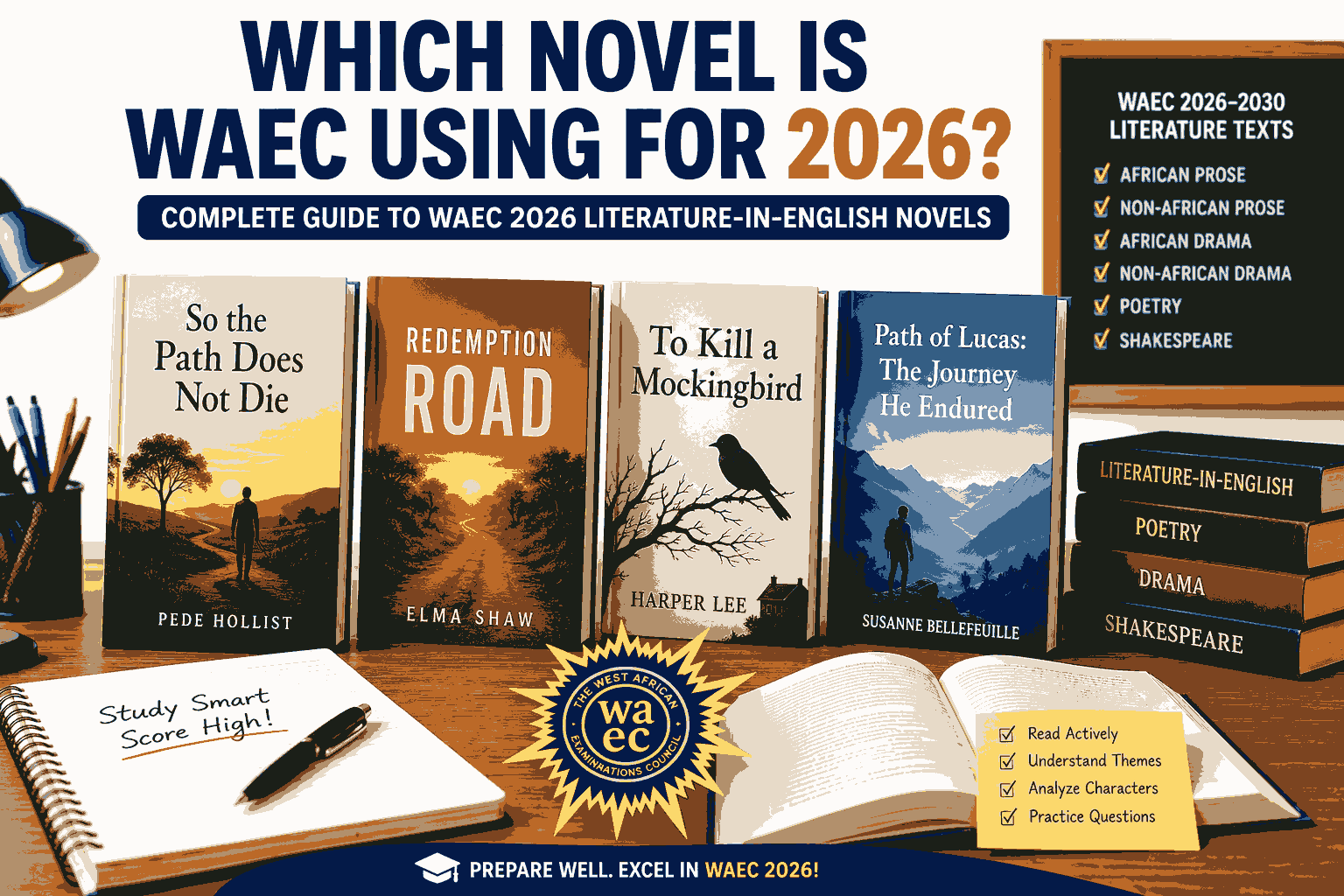
One of the most common questions among secondary school students preparing for the West African Senior School Certificate Examination (WASSCE) is: Which novel is WAEC using for 2026?
If you are preparing for WAEC 2026, knowing the correct prescribed novels is essential because questions in Literature-in-English are drawn directly from the approved texts. Reading the wrong novel can seriously affect your performance in the examination.
The good news is that WAEC has introduced a new set of Literature-in-English texts for the 2026–2030 examination cycle, replacing the books used between 2021 and 2025. Students, teachers, and schools across West Africa are already studying these texts in preparation for future examinations.
In this detailed guide, you will discover which novel WAEC is using for 2026, the complete list of prescribed prose texts, why these novels were selected, how to study them effectively, and answers to frequently asked questions.
Which Novel Is WAEC Using for 2026?
The answer depends on whether you are referring to the African Prose or Non-African Prose section of the Literature-in-English syllabus.
For the WAEC 2026–2030 Literature-in-English syllabus, the prescribed novels are:
African Prose
- So the Path Does Not Die by Pede Hollist
- Redemption Road by Elma Shaw
Non-African Prose
- To Kill a Mockingbird by Harper Lee
- Path of Lucas: The Journey He Endured by Susanne Bellefeuille
These are the official prose texts approved for WAEC Literature-in-English from 2026 to 2030.
Therefore, when students ask, “Which novel is WAEC using for 2026?”, the correct response is that WAEC has prescribed four major novels, divided into African and Non-African prose categories.
Understanding the WAEC 2026 Literature Text Changes
The WAEC Literature syllabus operates in cycles. Every few years, the examination body updates the prescribed texts to expose students to new literary works and broader perspectives.
The 2026–2030 syllabus introduces new novels, plays, and poems that reflect themes such as:
- Identity
- Social justice
- Migration
- Leadership
- Corruption
- Family values
- Human resilience
- Cultural conflict
These changes are designed to improve critical thinking, literary appreciation, and analytical skills among students.
As a result, students writing WAEC from 2026 onward must focus on the newly approved texts rather than those used in previous years.
So the Path Does Not Die by Pede Hollist
Overview of the Novel
So the Path Does Not Die is one of the most important novels in the WAEC 2026 Literature syllabus.
The novel explores the experiences of African immigrants and the challenges they face while trying to balance traditional values with modern realities.
Through compelling storytelling, Pede Hollist examines issues such as:
- Immigration
- Cultural identity
- Family expectations
- Personal ambition
- Social adaptation
The novel offers students a rich opportunity to analyze character development, symbolism, themes, and societal issues.
Why WAEC Selected This Novel
WAEC often chooses texts that address contemporary African experiences.
So the Path Does Not Die provides students with insights into:
- African culture
- Global migration
- Community relationships
- Moral decision-making
These themes are highly relevant in today’s interconnected world.
Redemption Road by Elma Shaw
Overview of the Novel
Another prescribed African prose text for WAEC 2026 is Redemption Road.
This novel is set against the backdrop of post-war recovery and examines the emotional, social, and psychological consequences of conflict.
The story highlights:
- Trauma and healing
- Forgiveness
- Redemption
- Human resilience
- National rebuilding
Students studying this novel will encounter complex characters and powerful narratives that encourage deep literary analysis.
Major Themes
Some of the major themes found in Redemption Road include:
Hope After Tragedy
Characters struggle to rebuild their lives despite painful experiences.
Personal Transformation
The novel demonstrates how individuals can grow through adversity.
Social Reconciliation
Communities must learn to forgive and move forward after conflict.
These themes make the novel highly suitable for WAEC examinations.
To Kill a Mockingbird by Harper Lee
One of the Most Famous WAEC 2026 Novels
When discussing which novel WAEC is using for 2026, it is impossible to ignore To Kill a Mockingbird.
Widely regarded as one of the greatest novels in modern literature, the book explores issues of:
- Racism
- Justice
- Morality
- Childhood innocence
- Social inequality
The story follows Scout Finch as she witnesses her father, Atticus Finch, defend an innocent Black man accused of a crime he did not commit.
Why Students Love This Novel
Many students find To Kill a Mockingbird engaging because it combines:
- Strong storytelling
- Memorable characters
- Powerful themes
- Real-world relevance
The novel also provides excellent material for essay questions and literary analysis.
Path of Lucas: The Journey He Endured by Susanne Bellefeuille
A Powerful Story of Determination
The fourth novel in the WAEC 2026 Literature syllabus is Path of Lucas: The Journey He Endured.
The novel follows the struggles and triumphs of Lucas as he navigates difficult circumstances and personal challenges.
Important themes include:
- Perseverance
- Courage
- Family support
- Personal growth
- Overcoming obstacles
Students are encouraged to pay close attention to character development and thematic progression throughout the novel.
Literary Importance
The novel presents universal lessons about endurance and resilience, making it an excellent choice for classroom discussion and examination purposes.
Complete WAEC Literature-in-English Texts for 2026–2030
Apart from the novels, students should study the full prescribed list.
Shakespearean Text
- Antony and Cleopatra — William Shakespeare
African Drama
- Once Upon an Elephant — Bosede Ademilua-Afolayan
- The Marriage of Anansewa — Efua Sutherland
Non-African Drama
- An Inspector Calls — J.B. Priestley
- A Man for All Seasons — Robert Bolt
African Prose
- So the Path Does Not Die — Pede Hollist
- Redemption Road — Elma Shaw
Non-African Prose
- To Kill a Mockingbird — Harper Lee
- Path of Lucas: The Journey He Endured — Susanne Bellefeuille
African Poetry
- Once Upon a Time — Gabriel Okara
- New Tongue — Elizabeth L. A. Kamara
- Night — Wole Soyinka
- Not My Business — Niyi Osundare
- Hearty Garlands — S.O.H. Afriyie-Vidza
- The Breast of the Sea — Syl Cheney-Coker
Non-African Poetry
- She Walks in Beauty — Lord Byron
- The Nun’s Priest’s Tale — Geoffrey Chaucer
- Digging — Seamus Heaney
- Still I Rise — Maya Angelou
- The Telephone Call — Fleur Adcock
- The Stone — Wilfrid Wilson Gibson
These texts form the foundation of WAEC Literature examinations from 2026 to 2030.
How to Study WAEC 2026 Novels Effectively
Knowing which novel WAEC is using for 2026 is only the first step. Success depends on how well you study the texts.
Read the Complete Novel
Avoid relying solely on summaries.
Reading the entire novel helps you understand:
- Plot development
- Character relationships
- Literary devices
- Themes
Create Character Profiles
Write notes about:
- Main characters
- Supporting characters
- Character traits
- Relationships
Identify Major Themes
WAEC often asks questions based on themes.
Focus on:
- Justice
- Identity
- Leadership
- Family
- Courage
- Redemption
Practice Past Questions
Answering past literature questions improves:
- Analytical skills
- Essay writing
- Time management
Join Study Groups
Group discussions help students discover new interpretations and perspectives.
Common Mistakes Students Make
Many students fail Literature because they:
Read Only Summaries
This limits understanding and analysis.
Ignore Character Development
Characters often form the basis of examination questions.
Memorize Instead of Understanding
WAEC rewards critical thinking and interpretation.
Neglect Poetry and Drama
Many candidates focus only on novels and lose marks in other sections.
Avoiding these mistakes can significantly improve your score.
Why the WAEC 2026 Novels Matter
The prescribed novels are not merely examination materials.
They help students:
- Develop reading habits
- Improve vocabulary
- Understand societal issues
- Build critical thinking skills
- Enhance writing ability
Each novel presents unique perspectives that prepare students for academic and real-life challenges.
Conclusion
If you have been asking which novel is WAEC using for 2026, the official prescribed prose texts are:
- So the Path Does Not Die by Pede Hollist
- Redemption Road by Elma Shaw
- To Kill a Mockingbird by Harper Lee
- Path of Lucas: The Journey He Endured by Susanne Bellefeuille
These novels form part of the WAEC Literature-in-English syllabus for the 2026–2030 examination cycle and should be studied thoroughly alongside the prescribed drama, poetry, and Shakespearean texts.
Students who begin reading early, understand themes and characters, and practice literary analysis will be better positioned to excel in WAEC Literature-in-English.
Also Read: Can I Register for WAEC Myself? Complete Guide for WAEC Self-Registration in Nigeria (2026)
Frequently Asked Questions (FAQs)
1. Which African novel is WAEC using for 2026?
WAEC is using So the Path Does Not Die by Pede Hollist and Redemption Road by Elma Shaw as African prose texts for the 2026–2030 syllabus.
2. Is To Kill a Mockingbird a WAEC novel for 2026?
Yes. To Kill a Mockingbird by Harper Lee is one of the official Non-African Prose texts approved for WAEC Literature-in-English from 2026 to 2030.
3. Will WAEC use the same novels from 2026 to 2030?
Yes. According to the approved syllabus, the prescribed Literature-in-English texts are intended for the 2026–2030 examination cycle unless WAEC announces future revisions.






+ There are no comments
Add yours