



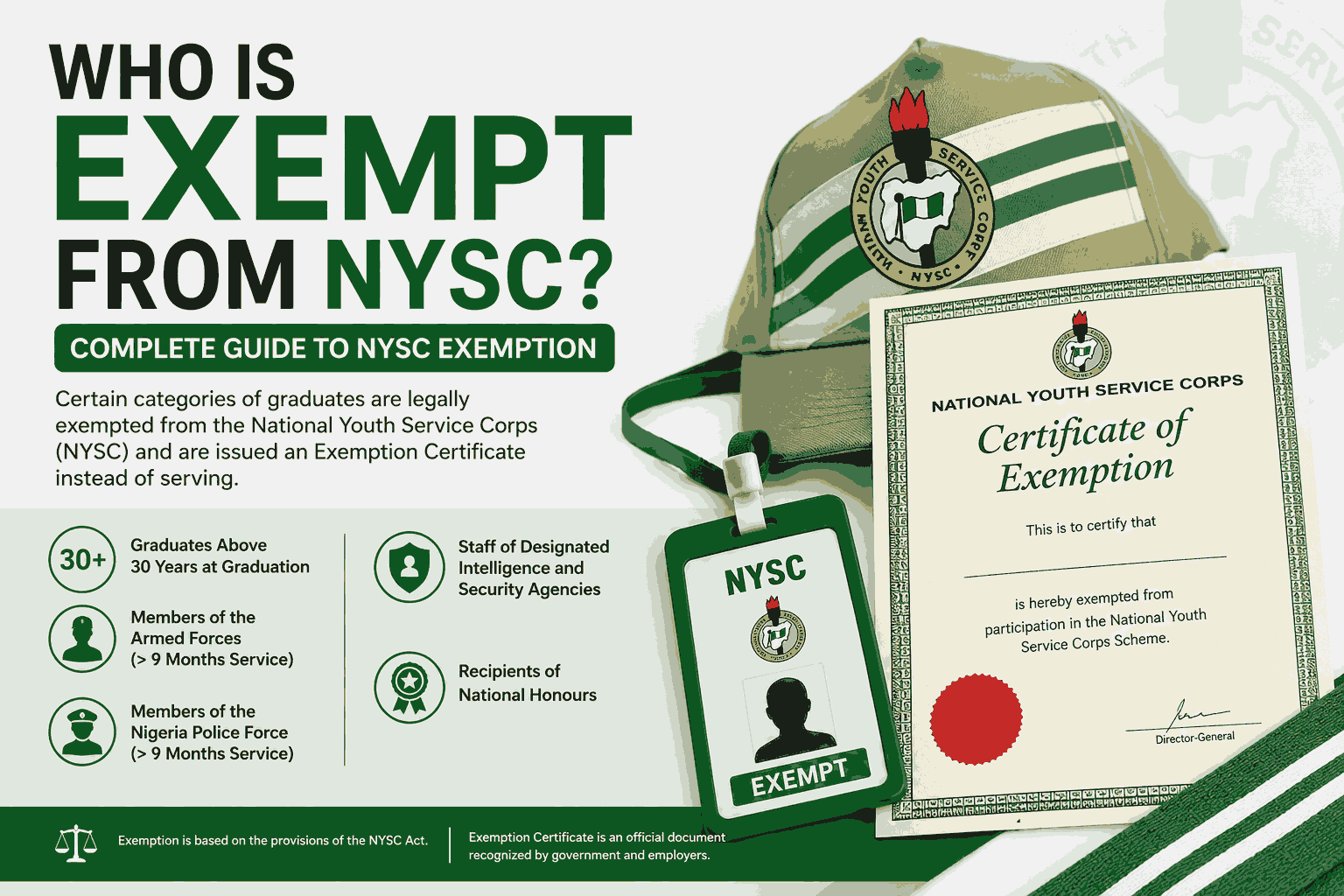
One of the most common questions asked by Nigerian students and graduates is: Who is exempt from NYSC? Whether you studied in Nigeria or abroad, understanding who is exempt from NYSC can help you know your obligations after graduation and avoid unnecessary confusion during mobilization.
The National Youth Service Corps (NYSC) is a mandatory one-year national service program established by the Nigerian government to promote national unity and development. However, not every graduate is required to participate. Nigerian law clearly identifies certain categories of graduates who qualify for exemption and are issued an Exemption Certificate instead of serving. According to the official NYSC guidelines, exemption applies to graduates who meet specific legal conditions such as age, prior service in security agencies, and other special circumstances.
This comprehensive guide explains who is exempt from NYSC, the legal basis for exemption, how exemption certificates are issued, common misconceptions, and everything graduates need to know.
What Is NYSC and Why Does It Matter?
Before discussing who is exempt from NYSC, it is important to understand the purpose of the scheme.
The National Youth Service Corps was established in 1973 to foster national integration after the Nigerian Civil War. The program requires eligible graduates to spend one year serving in a state different from their place of origin.
During the service year, corps members participate in:
- Orientation camp activities
- Community development projects
- Public and private sector employment assignments
- National integration programs
- Skills acquisition initiatives
For many employers in Nigeria, an NYSC Discharge Certificate, Exemption Certificate, or Exclusion Letter is an important employment requirement. Therefore, understanding who is exempt from NYSC is crucial for every graduate.
The Legal Basis: Who Is Exempt from NYSC?
The question who is exempt from NYSC is answered directly by the NYSC Act.
According to the National Youth Service Corps provisions, a graduate shall not be called up for service if certain conditions are met at the time of graduation. These individuals receive an official Certificate of Exemption rather than participating in the one-year service program.
The major categories of people exempted include:
- Graduates above the age of 30 at graduation
- Members of the Armed Forces who have served sufficiently
- Members of the Nigeria Police Force who have served sufficiently
- Staff of designated intelligence and security agencies
- Recipients of National Honours
Understanding these categories helps answer the frequently asked question: Who is exempt from NYSC?
Graduates Above 30 Years: The Most Common NYSC Exemption
Age-Based Exemption Explained
When discussing who is exempt from NYSC, the most common category is graduates who are over 30 years old at the time they graduate.
The critical factor is not your age during NYSC registration or mobilization. What matters is your age on the date your institution officially certifies your graduation.
Example 1
- Graduated at age 31
- Eligible for exemption
Example 2
- Graduated at age 29
- Registered for NYSC at age 31
- Not exempt
Example 3
- Graduated exactly at age 30
- NYSC determines eligibility using official graduation records
This rule answers one of the biggest concerns surrounding who is exempt from NYSC.
Why Age Matters
NYSC was created primarily as a youth development program. The government considers individuals above the prescribed age threshold outside the intended target group.
As a result, graduates above 30 receive an Exemption Certificate instead of participating in national service.
Military Personnel: Who Is Exempt from NYSC After Serving?
Another important answer to who is exempt from NYSC involves members of the Nigerian Armed Forces.
The law exempts graduates who have served in the Armed Forces of the Federation for more than nine months.
This includes personnel from:
- Nigerian Army
- Nigerian Navy
- Nigerian Air Force
The reasoning is straightforward. These individuals have already rendered significant national service through military duty.
Requirements
To qualify:
- Service must exceed nine months
- Appropriate service records must be available
- Verification by NYSC may be required
This category remains one of the official answers to the question who is exempt from NYSC.
Police Officers and NYSC Exemption
Nigeria Police Force Personnel
The next category under who is exempt from NYSC includes officers who have served in the Nigeria Police Force for more than nine months.
Just like military personnel, police officers are considered to have already contributed significantly to national service.
Why Police Officers Are Exempt
Police officers:
- Protect lives and property
- Maintain public order
- Support national security
- Participate in law enforcement operations
Because of these responsibilities, the law grants exemption from the standard NYSC service year.
For anyone asking who is exempt from NYSC, police service is one of the recognized exemptions.
Intelligence and Security Agency Staff
Security Personnel Covered by the Law
Another major answer to who is exempt from NYSC involves certain security agencies.
The law exempts staff members of designated intelligence and security organizations. These include:
State Security Service (SSS/DSS)
Personnel working with the Department of State Services qualify under the exemption provisions.
National Intelligence Agency (NIA)
Employees of the NIA are exempt because of their national security responsibilities.
Defence Intelligence Agency (DIA)
The DIA also falls within the exempted categories.
Other Authorized Security Organizations
Certain security organizations recognized under the law may also qualify.
Because these professionals already serve Nigeria in sensitive national roles, they are exempted from NYSC participation.
Therefore, when discussing who is exempt from NYSC, intelligence and security agency staff must be included.
Recipients of National Honours
A Special Category of Exemption
Many Nigerians do not realize that recipients of National Honours are also among those who answer the question who is exempt from NYSC.
The NYSC Act specifically exempts individuals who have been conferred with National Honours.
Examples of National Honours include:
- Officer of the Order of the Niger (OON)
- Member of the Order of the Niger (MON)
- Officer of the Federal Republic (OFR)
- Commander of the Order of the Niger (CON)
Because these awards recognize exceptional service to Nigeria, recipients are exempted from further mandatory service through NYSC.
Difference Between NYSC Exemption and NYSC Exclusion
Many graduates confuse exemption and exclusion.
Understanding the distinction is essential when discussing who is exempt from NYSC.
NYSC Exemption
An Exemption Certificate is issued to graduates who meet legal exemption conditions.
Examples include:
- Graduates above 30
- Military personnel
- Police officers
- Intelligence agency staff
- National Honour recipients
NYSC Exclusion
An Exclusion Letter applies mainly to graduates who are not eligible for mobilization due to the nature of their academic program.
Examples include:
- Part-time graduates
- Distance learning graduates
- Sandwich program graduates
These individuals are excluded rather than exempted.
This distinction is important because many people incorrectly assume exclusion and exemption mean the same thing.
How NYSC Determines Exemption Status
Understanding who is exempt from NYSC also requires knowing how NYSC verifies eligibility.
For Nigerian-Trained Graduates
The process usually involves:
Institutional Submission
Your institution sends graduate records to NYSC.
Verification
NYSC reviews:
- Date of birth
- Graduation date
- Academic qualifications
Classification
Graduates are classified as:
- Eligible for service
- Exempt from service
Certificate Production
Exemption Certificates are prepared for qualifying graduates.
For Foreign-Trained Graduates
The process is slightly different.
Foreign-trained graduates undergo:
- Credential evaluation
- Passport verification
- Physical documentation review
- Mobilization assessment
NYSC determines whether the graduate should serve or receive exemption.
This process ensures that only those who truly qualify under the law receive exemption status.
How to Obtain an NYSC Exemption Certificate
Many graduates know who is exempt from NYSC but are unsure how to collect their exemption certificate.
Nigerian-Trained Graduates
For graduates of Nigerian institutions:
- Institution submits records.
- NYSC determines exemption status.
- Certificate is produced.
- Certificate is sent back to the institution.
- Graduate collects the certificate from the institution.
Foreign-Trained Graduates
Foreign graduates generally:
- Present credentials for evaluation.
- Undergo physical verification.
- Receive exemption approval if eligible.
- Collect the certificate through the designated NYSC process.
Common Misconceptions About Who Is Exempt from NYSC
Myth 1: Turning 30 After Graduation Gives Automatic Exemption
False.
What matters is your age on your graduation date, not your age during registration.
Myth 2: Every Foreign Graduate Is Exempt
False.
Foreign graduates are assessed individually.
Many foreign graduates still serve if they meet the eligibility requirements.
Myth 3: Exemption Means You Did Something Wrong
False.
Being exempt is a legal classification recognized by the government.
It is not a punishment.
Myth 4: Exemption Certificate Is Less Valuable Than a Discharge Certificate
False.
Employers generally recognize both documents as official NYSC documents.
Why Understanding Who Is Exempt from NYSC Is Important
Knowing who is exempt from NYSC helps graduates:
- Plan career opportunities
- Avoid registration mistakes
- Understand legal obligations
- Prepare necessary documentation
- Navigate employment requirements
Many organizations require proof of NYSC status, whether through:
- Discharge Certificate
- Exemption Certificate
- Exclusion Letter
Understanding your status early can save considerable time and stress.
Final Thoughts on Who Is Exempt from NYSC
The question who is exempt from NYSC remains one of the most important concerns for Nigerian graduates.
Under the law, exemption primarily applies to graduates who were over 30 years old at graduation, members of the Armed Forces and Nigeria Police Force who have served sufficiently, designated intelligence and security personnel, and recipients of National Honours. These individuals are issued an NYSC Exemption Certificate instead of participating in the one-year service program.
If you believe you fall into any of these categories, ensure that your records and supporting documents are accurate and properly submitted for verification. Understanding who is exempt from NYSC can help you avoid unnecessary confusion and ensure compliance with official NYSC requirements.
Also Read: What Is the Next Step After Registering for NYSC? A Complete 2026 Guide for Every Prospective
FAQs
1. Who is exempt from NYSC because of age?
Graduates who are above 30 years old on the official date of graduation qualify for exemption and receive an Exemption Certificate.
2. Can I be exempt from NYSC if I am 31 during registration but graduated at 29?
No. NYSC considers your age at graduation, not your age during registration or mobilization.
3. Do foreign-trained graduates automatically qualify for exemption?
No. Foreign-trained graduates undergo credential evaluation and verification before NYSC determines whether they should serve or receive exemption.





+ There are no comments
Add yours